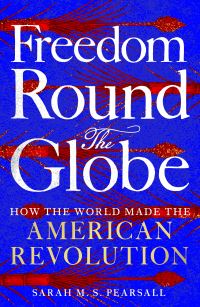
Freedom Round the Globe
£22.00A sweeping, epic and beautifully written new history of the American Revolution that resituates its origins in a global context; published to coincide with the Revolution’s 250th anniversary

 A History of the Sky in 300 Infographics
1 × £30.00 The Cauldron
1 × £25.00 Carthage
1 × £12.99
A History of the Sky in 300 Infographics
1 × £30.00 The Cauldron
1 × £25.00 Carthage
1 × £12.99 Subtotal: £67.99
Showing 65–80 of 195 resultsSorted by latest
A sweeping, epic and beautifully written new history of the American Revolution that resituates its origins in a global context; published to coincide with the Revolution’s 250th anniversary
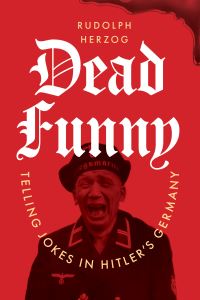
Hitler and Goring are standing on top of the Berlin radio tower. Hitler says he wants to do something to put a smile on the Berliners’ faces. Goring says, ‘Why don’t you jump?’ When a woman working in a factory told this joke to a colleague in Germany in 1943, she was arrested by the Nazis and sentenced to death by guillotine – it didn’t matter that her husband was a good German soldier who died in battle. In this groundbreaking work of history, Rudolph Herzog takes up such stories to show how widespread humour was during the Third Reich. It’s a fascinating and frightening history: from the suppression of the anti-Nazi cabaret scene of the 1930s, to jokes made at the expense of the Nazis during WWII, to the collections of ‘whispered jokes’ that were published in the immediate aftermath of the war. Herzog argues that jokes provide a hitherto missing chapter of WWII history. The jokes show that not all Germans were hypnotized by Nazi prop
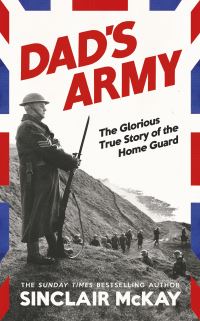
With the threat of invasion from Hitler’s forces looming large in 1940, British men of all ages and backgrounds assembled under the banner of the Home Guard. At its height, this voluntary force, much later nicknamed ‘Dad’s Army’, was made up of almost two million volunteers prepared to defend every corner of the kingdom. Numerous notable figures were involved including George Orwell, A.A. Milne, and C.S. Lewis; many women took part too, including in the Women’s Home Defence Force, which was formed in 1941. Sunday Times bestselling author Sinclair McKay tells the remarkable story of these courageous, highly trained and often pioneering men and women through original archival research, vivid storytelling and insights into the beloved television comedy that has shaped the national memory of the Home Guard.

‘Burn this!’ Why did so many letters between Lady Frances and Lady Betty begin this way? What did they have to hide? Alike in so many ways, political, passionate, argumentative and deeply intelligent. It’s no surprise that once Frances and Betty became sisters-in-law, they became close friends. There was just one problem. Frances was in love with Betty’s husband. Their unconventional solution they found was an ‘experiment in living’, a ménage à quatre. Setting up homes on the same street, they shared everything: money, meals, governesses, and husbands. When Susan Pedersen discovered their amazing cache of letters, she was spellbound. Her book follows their extraordinary friendship as both women seized every freedom afforded to them, leaving their drawing rooms for the streets and the soapbox, joining the fight for the women’s vote. This is the untold story of two women who carved a path together through an elite male world.

A Waterstones Best History Book 2025
A BBC History Magazine Book of the Year 2025
‘Learned, entertaining and highly approachable’ BOB MORTIMER
‘A treat’ ALICE LOXTON
‘Five stars from me…’ AL MURRAY
An unmissable collaboration between two comedy legends – an irresistible, family-friendly deep dive into the murky lives of the British monarchy.
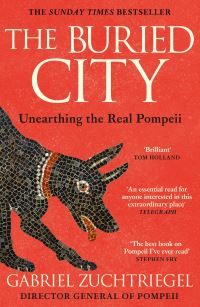
Pompeii is a world frozen in time. There are unmade beds, dishes left drying, tools abandoned by workmen, bodies embracing with love and fear. And alongside the remnants of everyday life, there are captivating works of art: lifelike portraits, exquisite frescos and mosaics, and the extraordinary sculpture of a sleeping boy, curled up under a blanket that’s too small. ‘The Buried City’ reconstructs the catastrophe that destroyed Pompeii on 24 August 79 CE, and offers a behind-the-scenes tour of the city as it was before: who lived here, what mattered to them, and what happened in their final hours. It gives us a vivid sense of Pompeii’s continuing relevance, and proves that ancient history is much closer to us than we think.
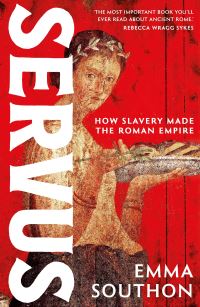
We associate the Romans with majesty and greatness: we marvel at their straight roads and innovative underfloor heating, at the dominance of their army and navy, at the grandeur of their palaces and temples. But the Romans were also enslavers. They built an empire on the backs of millions of people snatched from their homes in the aftermath of war, kidnapped from the streets, sold into slavery as punishment or, simply, born enslaved. ‘Servus’ takes us into the invisible spaces of the Roman world, where millions of enslaved lives were unwillingly dedicated to the perpetuation of the empire that owned them.
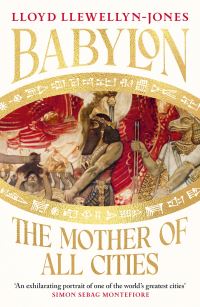
Babylon often appears more myth than history. Purportedly the site of the Hanging Gardens and the Tower of Babel, its infamous presence in the Bible has made it a byword for sinful decadence. But Babylon was a real place teeming with life, a bustling mega-city on the Euphrates where schoolteachers, artisans, priests, slaves, prostitutes and soldiers rubbed shoulders in maze-like streets and busy marketplaces. The city was home to some extraordinary rulers, from Hammurabi the great lawgiver to Nebuchadnezzar II, the conqueror-king, under whose reign the city glistened in gold and lapis lazuli. In this book, Lloyd Llewellyn-Jones brings the city vividly to life, tracing its foundation through to its world domination, and subsequent decline, fall and ruin into dust.
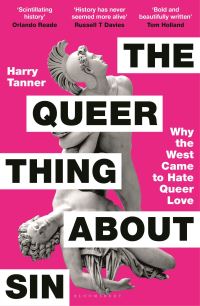
A gripping new journey through ancient history, uncovering the origins of homophobia and the untold stories of those who dared to love.
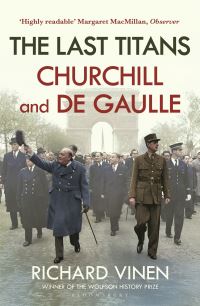
A compelling dual biography of Winston Churchill and Charles de Gaulle that shines new light on two of the greatest figures of the twentieth century.
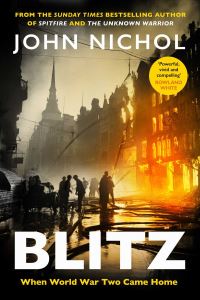
From the Sunday Times bestselling author of Spitfire and The Unknown Warrior, Blitz is a searing account of a nation at war, told through the eyes of those who endured the onslaught.
For almost five million years, humans have been locked in a relationship with morality, inventing and reinventing the concepts of ‘Good’ and ‘Evil’, and weaving them into our cities, laws and customs. Morality is often associated with restraint and coercion; restriction and sacrifice; inquisition, confession and a guilty conscience. Joyless and claustrophobic, it is a device used to shames us into compliance. This impression is not entirely incorrect, but it is certainly incomplete. Using our past as a basis for a new understanding of our future, Hanno Sauer traces humanity’s fundamental moral transformations from our earliest ancestors through to the present day, when it seems we have never disagreed more over what it means to be good. Our current political disagreements may feel like the end of the world, but where will the evolution of morality take us next?

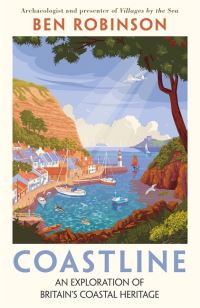
From prehistory to the modern era, our coastline had shaped Britain, not only physically but socially, economically and culturally. Far from being at the margins of national interests, the coast has been at the heart of the British people’s most important endeavours and central to era-defining national events. For thousands of years the coastline has been both Britain’s frontier and its connection to the wider world. Exploring key coastal themes throughout British history and introducing some of the most significant, intriguing and quirky places that express the pivotal role our coastal heritage has played, archaeologist and presenter Ben Robinson looks to our coastline to tell not only the stories of our past, but also of our present.

Weimar looms large in German history: a crucible of democracy and dictatorship. This ancient town nestled in the heart of the country was home to some of Europe’s greatest thinkers, Goethe and Schiller, Liszt and Nietzsche among them. It gave its name to the ambitious Weimar Republic crafted in the aftermath of the First World War. But it was also where fascism took hold. Where Bauhaus architects first experimented with new ways of living, Buchenwald was dug out of a beech forest. This book shows us a town and its people on the edge of catastrophe. Drawing on a wealth of new archival research, historian Katja Hoyer takes us from 1919 to 1939 as she tells the stories of the men and women who lived through the new republic and Hitler’s regime. We encounter a vividly drawn cast of characters, from bookbinder Carl Weirich and hotel owners Rosa and Arthur Schmidt, to Friedrich Nietzsche’s sister Elisabeth.
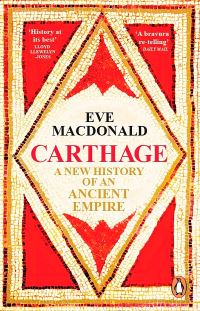
Carthage was a power that dominated the western Mediterranean for almost six centuries before its fall to Rome. The history of the realm and its Carthaginians was subsumed by their conquerors and, along the way, the story of the real Carthage was lost. In this landmark new history, Eve MacDonald tells the essential story of the lost culture of Carthage and of its forgotten people, using archaeological analysis to uncover the history behind the legend. A journey that takes us the Phoenician Levant of the early Iron Age to the Atlantic and all along the coast of Africa, the book puts the city and the story of North Africa once again at the centre of Mediterranean history. Reclaimed from the Romans, this is the Carthaginian version of the tale, revealing to us that, without Carthage, there would be no Rome.
A History of the Sky in 300 Infographics
1 × £30.00 The Cauldron
1 × £25.00 Carthage
1 × £12.99 Subtotal: £67.99