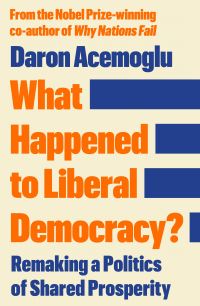
“What Happened to Liberal Democracy?” has been added to your basket.
View basket
Showing 1–16 of 21 resultsSorted by latest
-
£25.00
Long considered the ‘boring’ corner of finance, bonds are anything but. They are bigger than the stock market and rival even the global banking system in influence. But they are also misunderstood – treated as mere debt, when in fact their impact is radically different. From medieval Venice to modern Wall Street, Robin Wigglesworth uncovers the a sweeping, unveiling story of the bond market. With clarity and wit, this is a people’s history of finance: rich in drama, full of colourful characters, and bursting with insights. Bonds have funded everything from the Crusades to climate tech, Netflix series to AI data centres. Pooling capital from citizens and merchants at an unmatched scale, they have been the hidden force behind some of humanity’s highest achievements and greatest calamities. This isn’t just a book about the past. It’s a guide to the future of the finance, and a love letter to the engine that keeps it running.
-
£25.00
From its inception, liberalism offered a glittering promise of shared prosperity, equality, democratic values and the free pursuit of knowledge. At first, it flourished. And then it faltered. Once a tantalising beacon of hope, it began to erode and decay at the hands of elitism, intolerance and rising autocracy. One could say that liberalism is broken. So what comes next? Nobel prize-winning co-author of ‘Why Nations Fail’ Daron Acemoglu charts the rise and fall of liberal democracy, and offers hope for a way forward: a new theory that lays the groundwork for how we can – and must – remake liberalism before it’s too late.
-
£10.99
A Financial Times Best Book of 2025
A Forbes Best Business Book of 2025
-
£12.99
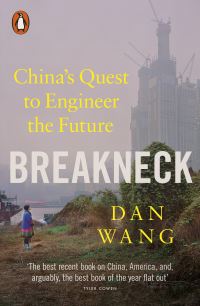
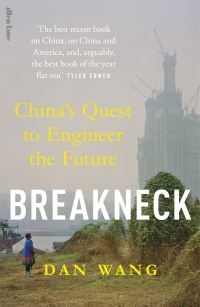
America used to pride itself on ambition. Today, it looks stuck. Meanwhile, China has been busy building the future. Over the past six years, technology analyst Dan Wang lived through China’s astonishing, messy progress and the dissolution of its relationship to the West. In ‘Breakneck’, Wang offers a new framework for understanding China – which helps us to see global geopolitics more clearly too.
-
£18.99
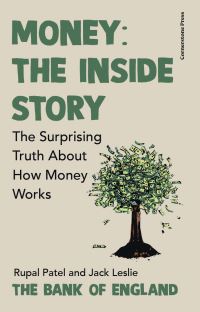
Where does money come from? What gives a 1 coin its value? And whose job is it to actually print banknotes? Most of us think about money every day. But we tend not to think about how weird it is: a totally abstract concept, built entirely on trust, which somehow makes the whole world function. The Bank of England know more about money than most – after all, they are the ones responsible for making sure it works. Now, the Bank answer all the questions about money that you’ve never thought to ask – from what makes money money, to how private banks create money every time they give out a loan, to what happens to cash when it’s past its sell by date (it’s often moulded into garden furniture, as it turns out). Along the way, they offer your one-stop guide to how money really works – and where it might be going next.
-
£25.00
The crises that face us in the twenty-first century are global and interconnected: amongst many others, climate change exacerbates the water crisis, which in turn impacts health. Yet, as Mariana Mazzucato argues, we have failed to treat these as collective goals with shared agendas. This, she argues, is not by coincidence, but by design. In this ambitious and urgent new book, Mazzucato presents a systematic and scalable vision of successful government that creates value, addresses inequalities, and serves collective ends. Emphasizing a need to shift from reactively putting bandages on market failures to proactively shaping economies that actually work, she proposes a new economic theory of the common good. The book outlines five pillars of progressive government and demonstrates how they can help us tackle the most pressing challenges of our time.
-
£12.99
Wars are expensive, both in human terms and monetary ones Since at least the 1640s, in the aftermath of the British Civil Wars, the phrase ‘blood and treasure’ has sought to encapsulate these costs. Two economic notions, in particular, feature in this book: incentives and institutions. A rational look at incentives explains even the most seemingly irrational behaviour – and few things are as irrational as war. This book examines why Genghis Khan should be regarded as the father of globalisation, how New World gold and silver kept Spain poor, why some economists think of witch trials as a form of ‘non-price competition’, how pirate captains were pioneers of effective HR techniques, how handing out medals hurt the Luftwaffe in the Second World War and why economic theories helped to create a tragedy in Vietnam.
-
£22.00
A timely and lively guide explaining the stakes, players and rules of trade wars, and what the future will hold.
-
£9.99
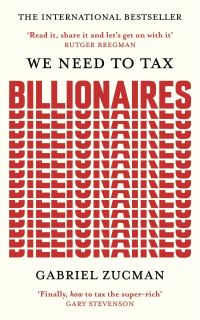
While ordinary citizens pay around half of their income in tax, billionaires pay often close to zero income tax – because they earn almost all their income through companies. The solution is the 2% ‘Zucman tax’: a minimum tax on the ultra-rich themselves, advocated by economist and global expert on the taxation of wealth Gabriel Zucman. We need to tax billionaires, and this book shows us why now is the moment.
-
£22.00
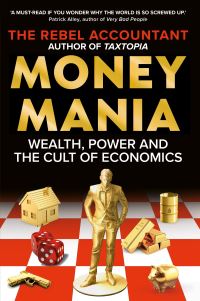
An illuminating and often hilarious exposé of the dubious world of the people whose job is to tell us that the world of money can be predicted with almost scientific accuracy – when the truth is that it fails again and again. And that from the Greeks onwards, Economics has long been driven by vested interests, reckless predictions and at times a staggering lack of common sense. The Rebel Accountant strips away the complexities and gives us the lowdown on why everything you thought about the world of Economics is not only wrong, but is has been responsible for some of the greatest fails of all time. This is MONEYMANIA.
-
£12.99
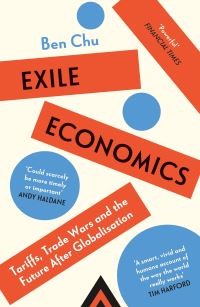
The dangerous race for self-sufficiency has begun. Be warned Nations are turning away from each other. Faith in globalisaton has been fatally undermined by the pandemic, the energy crisis, surging trade frictions and swelling great power rivalry. A new vision is vying to replace what we’ve known for many decades. This vision – ‘Exile Economics’ – entails a rejection of interdependence, a downgrading of multilateral collaboration and a striving for greater national self-sufficiency. The supporters of this new order argue it will establish genuine security, prosperity and peace. But is this promise achievable? Or a seductive delusion? Through the stories of globally traded commodities, economics journalist Ben Chu illustrates the intricate web of interdependence that has come to bind nations together – and underlines the dangers of this new push to isolationism.
-
£22.00
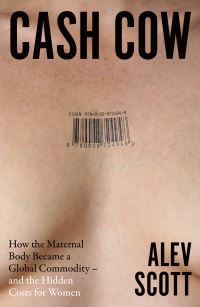
‘Captivating, mind-boggling and deeply disturbing’ – Maureen Freely
‘Humane, thoughtful and urgent – this book will make you think, make you laugh, make you cry, but also make you burn with rage’ – Dr Mary Wellesley
A thought-provoking deep dive into the global fertility industry and the commodification of the maternal body
-
£10.99
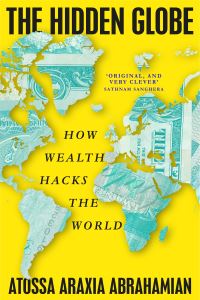
Borders draw one map of the world; money draws another. A journalist’s riveting account exposes a parallel universe exempt from the laws of the land and reveals how it became a haven for the rich and powerful.
-
£12.99
Assume nothing, question everything. This is the message at the heart of ‘Freakonomics’, Levitt and Dubner’s rule-breaking, iconoclastic book about crack dealers, cheating teachers and bizarre baby names that turned everyone’s view of the world upside-down and became an international multi-million-copy-selling phenomenon.
-
£25.00
America used to pride itself on ambition. Today, it looks stuck. Meanwhile, China has been busy building the future. Over the past six years, technology analyst Dan Wang lived through China’s astonishing, messy progress and the dissolution of its relationship to the West. In ‘Breakneck’, Wang offers a new framework for understanding China – which helps us to see global geopolitics more clearly too.

 PMC Tender Is The Night