How the world made the West
£12.99‘One of the most fascinating and important works of global history to appear for many years’ (William Dalrymple), this epic debut from Josephine Quinn rewrites the story of the Western world.
We recently launched our new website and are facing a few teething issues. If you see any problems please contact us.
We recently launched our new website and are facing a few teething issues. If you see any problems please contact us.

Showing all 7 resultsSorted by latest
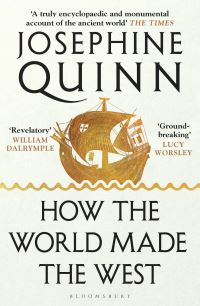
‘One of the most fascinating and important works of global history to appear for many years’ (William Dalrymple), this epic debut from Josephine Quinn rewrites the story of the Western world.

The Enlightenment did not begin in Europe. Its true origins lie thousands of miles away on the island of Madagascar, in the late 17th century, when it was home to several thousand pirates. This was the Golden Age of Piracy, a period of violent buccaneering and rollicking legends – but it was also, argues anthropologist David Graeber, a brief window of radical democracy, as the pirate settlers attempted to apply the egalitarian principles of their ships to a new society on land. For Graeber, Madagascar’s lost pirate utopia represents some of the first stirrings of Enlightenment political thought. In this jewel of a book, he offers a way to ‘decolonise the Enlightenment’, demonstrating how this mixed community experimented with an alternative vision of human freedom, far from that being formulated in the salons and coffee houses of Europe.
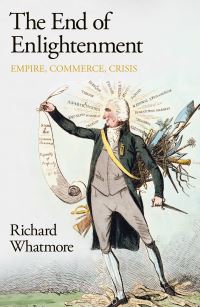
‘The End of Enlightenment’ offers a radical re-evaluation of one of the most important moments in human history. Tracing around the world the changing perspectives of economists, philosophers, politicians, and polemicists, historian Richard Whatmore argues that, for figures as diverse as David Hume, Edmund Burke, Adam Smith and Mary Wollstonecraft, the Enlightenment was a profound failure. Returning us to the tumultuous events and ideas of the eighteenth century, and digging deep into the thought of the men and women who defined their age, this book is a lucid exploration of disillusion and intellectual transformation, a brilliant meditation on our continued assumptions about the past, and a glimpse of the different ways our world might be structured.
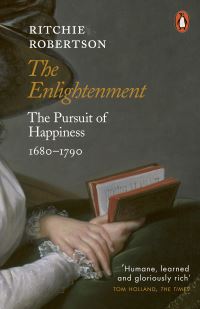
The Enlightenment is one of the formative periods of Western history, yet more than 300 years after it began, it remains controversial. It is often seen as the fountainhead of modern values such as human rights, religious toleration, freedom of thought, scientific thought as an exemplary form of reasoning, and rationality and evidence-based argument. Others accuse the Enlightenment of putting forward a scientific rationality which ignores the complexity and variety of human beings, propagates shallow atheism, and aims to subjugate nature to so-called technical progress. Ritchie Robertson engages with all these views to show that the Enlightenment sought above all to increase human happiness in this world by promoting scientific inquiry and reasoned argument and by challenging the authority traditionally assumed by the Churches.

One of the world’s greatest contemporary thinkers and author of ‘The Better Angels of Our Nature’ (described by Bill Gates as ‘the most inspiring book I have ever read’) shows how to think afresh about the human condition and to meet the challenges that confront us. Is modernity really failing? Or have we failed to appreciate progress and the ideals that make it possible? If you follow the headlines, the world in the 21st century appears to be sinking into chaos, hatred and irrationality. Yet Steven Pinker shows that this is an illusion – a symptom of historical amnesia and statistical fallacies.

In this text the authors show how leading thinkers of the movement believed that by means of scientific endeavour the essential order of nature could be systematically explained, its processes mastered and all its secrets revealed.
No products in the basket.
Notifications