Showing all 9 resultsSorted by latest
-
£10.99
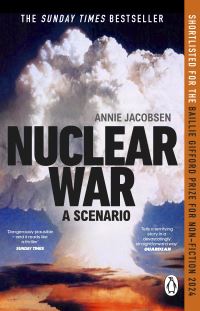
The first rule of nuclear war is that there are no rules. Up to now, no one outside of official circles has known exactly what would happen if a rogue state launched a nuclear missile at the Pentagon. Second by second and minute by minute, these are the real-life protocols that choreograph the end of civilisation as we know it. If a single nuclear missile is launched, it provokes two dozen in return. Frantic calls over secure lines work to confirm the worst as armoured helicopters are scrambled outside. Decisions over hundreds of millions of lives need to be made within six minutes, based on partial information, knowing that once launched, nothing is capable of halting the destruction. Because the plans for General Nuclear War are among the most classified secrets held by the United States government, this book takes the reader up to the razor’s edge of what can legally be known.
-
£10.99
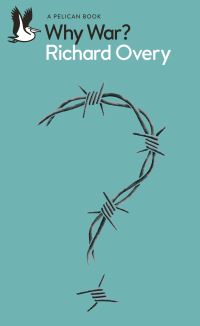
There can be few more important but also more contentious issues than attempting to understand the human propensity for conflict. Our history is inextricably tangled in wave after wave of inter-human fighting from as far back as we have records. How can we make sense of what Einstein called ‘the dark places of human will and feeling’? Richard Overy draws on a lifetime’s study of conflict to write this challenging, invaluable book.
-
£18.99
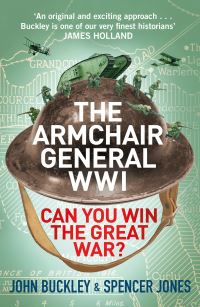
Assume the role of real Generals, Leaders, Soldiers and Intelligence Officers in the Allied Powers during WWI, from Lord Kitchener to the Kaiser. Explore the key moments of the war with real contemporaneous intelligence, from 1914’s July Crisis, to the Somme via Gallipoli. From battlefields to war cabinets, each tactical and strategic decision you make leads to a different outcome. Will you follow the path of the past – or shape a new history?
-
£10.99
An acclaimed expert on violence and seasoned peacebuilder explains the five reasons why conflict (rarely) blooms into war, and how to interrupt that deadly process. It’s easy to overlook the underlying strategic forces of war, to see it solely as a series of errors, accidents, and emotions gone awry. It’s also easy to forget that war shouldn’t happen-and most of the time it doesn’t. Around the world there are millions of hostile rivalries, yet only a tiny fraction erupt into violence. Too many accounts of conflict forget this. With a counterintuitive approach, Blattman reminds us that most rivals loathe one another in peace. That’s because war is too costly to fight.
-
£20.00
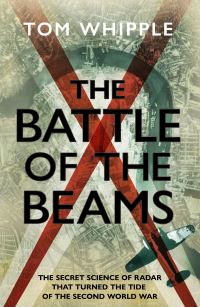
Summer 1939. War is coming. The British believe that, through ingenuity and scientific prowess, they alone have a war-winning weapon: radar. They are wrong. The Germans have it too. They believe that their unique maritime history means their pilots have no need of navigational aids. Flying above the clouds they, like the seafarers of old, had the stars to guide them, and that is all that is required. They are wrong. Most of the bombs the RAF will drop in the first years of the war land miles from their target. They also believe that the Germans, without the same naval tradition, will never be able to find targets at night. They are, again, wrong. In 1939 the Germans don’t just have radar to spot planes entering their airspace, they have radio beams to guide their own planes into enemy airspace. War is coming, and it is to be a different kind of war.
-
£12.99
One of the greatest and most terrible years in world history. ‘This war has now assumed the character’, wrote Benito Mussolini, before 1941 was six months old, ‘of a war between two worlds’, and the Italian dictator had rarely predicted more truly. Before the year had ended, following Hitler’s surprise assault on Russia and the Japanese attack on Pearl Harbour, thirty-seven nations were engaged in an all-out war reminiscent of Armageddon, ‘the battle of that great day of God Almighty’. Richard Collier’s narrative spans both this entire, devastating year, as well as the events that led up to it.
-
£12.99
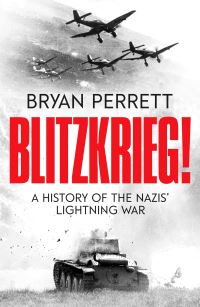
If Hitler had failed in his invasion of Western Europe in 1940 he could well have been assassinated by a group of his senior officers. But he decisively defeated the combined efforts of the British, French, Dutch and Belgian armies in a matter of days. The technique employed was known as Blitzkrieg or Lightning War. Nothing would be the same again. Although strands were clearly apparent by 1918, it was perfected through the interwar years before being deployed with terrifying effect by the Nazis at the outbreak of the Second World War. Eventually, other combatants would employ similar methods and the tide would turn. As well as discussing the developing nature of tactics, fighting vehicles and aircraft from 1918 onwards, the author examines the potent workings of Blitzkrieg in-depth, describing not only its obvious triumphs but also its fatal flaws.
-
£40.00
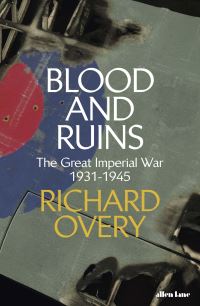
Richard Overy sets out to recast the way in which we view the Second World War and its origins and aftermath. He argues that this was the ‘great imperial war’, a violent end to almost a century of global imperial expansion which reached its peak in the ambitions of Italy, Germany and Japan in the 1930s and early 1940s, before descending into the largest and costliest war in human history and the end, after 1945, of all territorial empires. How war on a huge scale was fought, supplied, paid for, supported by mass mobilization and morally justified forms the heart of this account. Above all, Overy explains the bitter cost for those involved in fighting, and the exceptional level of crime and atrocity that marked these imperial projects, the war and its aftermath. This war was as deadly for civilians as it was for the military, a war to the death over the future of the global order.
-
£10.99
An elegant pocket hardback edition of Sun Tzu’s definitive work on military strategy

 Cat In The Hat