Showing 13–24 of 62 resultsSorted by latest
-
£9.99
This novel is based on the true story of Lale and Gita Sokolov, two Slovakian Jews, who survived Auschwitz and eventually made their home in Australia. In that terrible place, Lale was given the job of tattooing the prisoners marked for survival – literally scratching numbers into his fellow victims’ arms in indelible ink to create what would become one of the most potent symbols of the Holocaust. Lale used the infinitesimal freedom of movement that this position awarded him to exchange jewels and money taken from murdered Jews for food to keep others alive. If he had been caught he would have been killed; many owed him their survival.
-
£25.00
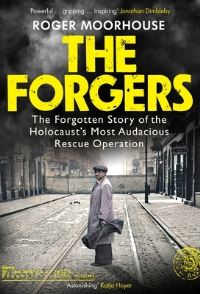
Between 1940 and 1943, a group of Polish diplomats in Switzerland engaged in a wholly remarkable – and until now, completely unknown – humanitarian operation. In concert with Jewish activists, they masterminded a systematic programme of forging passports and identity documents for Latin American countries, which were then smuggled into German-occupied Europe to save the lives of thousands of Jews facing extermination in the Holocaust. ‘The Forgers’ tells this extraordinary story.
-
£25.00
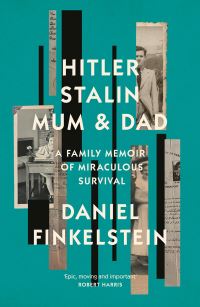
THE INSTANT SUNDAY TIMES BESTSELLER
‘Epic, moving and important’ ROBERT HARRIS
‘A modern classic’ OBSERVER
‘An unforgettable epic of a book’DAILY MAIL
-
£12.99
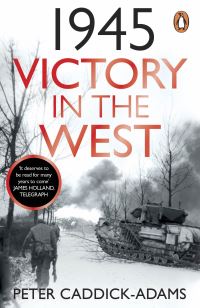
March 1945. Allied troops are poised to cross the Rhine and sweep on into Germany. Victory is finally within their grasp. But if they believe this victory can be easily won, they face swift disillusionment. The final 100 days of the Second World War will prove to be bitterly and bloodily fought, village by village, town by town. In this book, military historian Peter Caddick-Adams brings this closing stage of the Allies’ fight against Nazi Germany brilliantly to life. He explores the immense challenges they faced in crossing the Rhine on a 300-mile front. He tells stories of individual acts of resolve and heroism, of often exhausted troops pressing forward attacks in the face of ferocious resistance.
-
£8.99
An almighty storm hit Berlin in the last days of April 1945. Enveloped by the unstoppable force of East and West, explosive shells pounded buildings while the inhabitants of a once glorious city sheltered in dark cellars – just like their Fuhrer in his bunker. The Battle of Berlin was a key moment in history; marking the end of a deathly regime, the defeated city was ripped in two by the competing superpowers of the Cold War. In this book, historian Sinclair McKay draws on never-before-seen first-person accounts to paint a picture of a city ravaged by ideology, war and grief. Yet to fully grasp the fall of Berlin, it is crucial to also explore in detail the years beforehand and to trace the city being rebuilt, as two cities, in the aftermath.
-
£10.99
What happened to the books that were too valuable to burn? The story of a Jewish chef whose bestselling cookbook was expropriated under the Nazi regime. Alice Urbach had her own cooking school in Vienna, but in 1938 she was forced to flee to England, like so many others. Her younger son was imprisoned in Dachau, and her older son, having emigrated to the United States, became an intelligence officer in the struggle against the Nazis. Returning to the ruins of Vienna in the late 1940s, she discovers that her bestselling cookbook has been published under someone else’s name. Now, eighty years later, the historian Karina Urbach – Alice’s granddaughter – sets out to uncover the truth behind the stolen cookbook, and tells the story of a family torn apart by the Nazi regime, of a woman who, with her unwavering passion for cooking, survived the horror and losses of the Holocaust to begin a new life in America.
-
£12.99
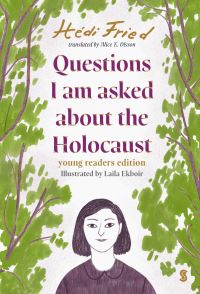
A young readers’ edition of the bestselling book from Auschwitz survivor Hédi Fried that answers lasting questions about the Holocaust.
-
£10.99
The story of two unlikely friends, one born in 1970s Britain to Indian immigrant parents, and the other who arrived from Nazi Germany in 1939, fleeing persecution. It is about migration, anti-Semitism, racism, family, belonging, grief and resilience.
-
£25.00
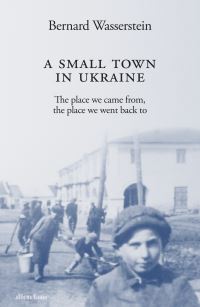
Decades ago, the historian Bernard Wasserstein set out to uncover the hidden past of the town 40 miles west of Lviv where his family originated: Krakowiec (Krah-KOV-yets). In this work he recounts its dramatic and traumatic history. ‘I want to observe and understand how some of the great forces that determined the shape of our times affected ordinary people.’ The result is an exceptional, often moving book. Wasserstein traces the arc of history across centuries of religious and political conflict, as armies of Cossacks, Turks, Swedes and Muscovites rampaged through the region.
-
£22.00
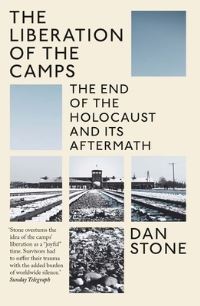
The defining event of 20th-century Europe – the extermination of millions of Jews – has been commemorated, institutionalised and embedded in our collective consciousness. But in this nuanced and perceptive new history, Dan Stone contends that the true dimension of the horror wrought by the Nazis is inadvertently brushed aside in our current culture of commemoration. This is due in part to practical or conceptual challenges, such as the continent-wide scale of the crime and the multiplicity of sources in many languages; and in part to an unwillingness to confront the reality that the Holocaust could not have happened without the assistance of numerous non-Nazi states and agents. This work is structured around four themes – trauma, collaboration, genocidal fantasy and post-war consequences.
-
£10.99
A moving, deeply researched account of survivors’ experiences of liberation from Nazi death camps and the long, difficult years that followed
-
£9.99
THE INTERNATIONAL BESTSELLER
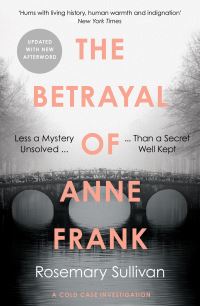
‘Hums with living history, human warmth and indignation’ New York Times
Less a mystery unsolved than a secret well kept
The mystery has haunted generations since the Second World War: Who betrayed Anne Frank and her family? And why?