Minority Rule
£10.99The explosive debut from political commentator Ash Sarkar, Minority Rule breaks down how the power of ordinary people is under attack by an elite minority – and how we can focus our energy on the real problem at hand.

Showing 1–12 of 69 resultsSorted by latest
The explosive debut from political commentator Ash Sarkar, Minority Rule breaks down how the power of ordinary people is under attack by an elite minority – and how we can focus our energy on the real problem at hand.
Between a quarter and a fifth of young people in the UK now suffer a mental disorder. One in four adults are prescribed psychiatric medication. These numbers represent a huge and recent expansion in mental health labelling, but reveal nothing of the experience of those seeking help. In ‘The Unfragile Mind’, Gavin draws on conversations with patients, colleagues, and his thirty years of practice to explore the chequered history of psychiatry, the nature of mental health and ill-health, and the problems – including mood disorders, trauma, anxiety and addiction – that he addresses daily. The mind, he argues, is dynamic and adaptive – better addressed not with rigid labels and protocols, but with curiosity, kindness, humility and hope.

Modern life encourages us to pursue the perfect identity. Whether we aspire to become the best lawyer or charity worker, life partner or celebrity influencer, we emulate exemplars that exist in the world Рhoping it will bring us happiness. But this often leads to a complex game of envy and pride. We achieve these identities but want others to imitate us. We disagree with those whose identities contradict ours Рleading to polarisation and even violence. And yet when they thump against us, we are ashamed to ring hollow. In this book, philosopher Alexander Douglas seeks an alternative wisdom. Searching the work of three thinkers Рancient Chinese philosopher Zhuangzi, Dutch Enlightenment thinker Benedict de Spinoza, and 20th Century French theorist Ren̩ Girard Рhe explores how identity can be a spiritual violence that leads us away from truth.

Vladimir Lenin, an occasional resident of North London who went on to other things, has been credited with once saying that there are decades where nothing happens but weeks when decades happen. The first two and a half decades of this century in Britain have had plenty of those weeks. Indeed, our recent history has at times resembled an episode of ‘Casualty’, the long-running BBC hospital drama in which every hedge trimmer slips, every gas pipe leaks, every piece of scaffolding collapses and everyone ends up in intensive care. In ‘Haywire’, Andrew Hindmoor makes sense of the deluge of events which have rained down on Britain since 2000, from the Iraq War to financial collapse, austerity to Brexit, as well as more easily forgotten moments such as the MP’s expenses scandal.
What with machine learning and deep learning, chat bots and robots, generative AI and deep fakes, the modern landscape of artificial intelligence is suddenly a very real place to explore. But how are you expected to navigate this exciting and potentially terrifying new world? ‘Navigating Artificial Intelligence’ provides the map you need to start exploring some seriously big ideas.
This stirring new collection brings together George Orwell’s most cherished essays with lesser-known gems, all penned with the clarity, wit and charm which characterise his writing. Showcasing his vivid personal encounters and perceptive insights – from his musings on tree planting to his warnings against the threat of atomic destruction – this collection is sure to delight Orwell fans, both old and new.
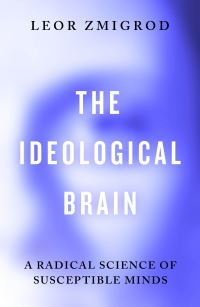
The human brain faces a set of dilemmas every day: how to achieve coherence from fragmented sensory inputs and how to attain connection with other people in an increasingly atomized and isolating world. Ideologies offer a shortcut, providing easy answers, scripts to follow, and a sense of shared identity. Whether our ideologies are far-right, far-left, nationalist, religious, or even progressive, they simplify our understanding and give us organizing frameworks through which to act and interact with others. But ideologies come at a cost: demanding conformity and suppressing individuality through rigid rules, repetitive rituals, and intolerance. Once ideologies grip our minds, they fundamentally transform us, making us less sensitive and adaptable. Drawing on her groundbreaking research, Dr Leor Zmigrod uncovers the hidden mechanisms driving our beliefs and behaviours.
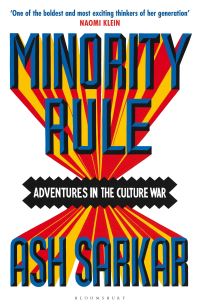
The explosive debut from political commentator Ash Sarkar, Minority Rule breaks down how the power of ordinary people is under attack by an elite minority – and how we can redirect our energy to the real problem at hand.
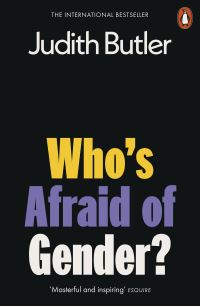
Judith Butler, the ground-breaking philosopher whose work has redefined how we think about gender and sexuality, confronts the attacks on gender that have become central to right-wing movements today. Global networks have formed ‘anti-gender ideology movements’ dedicated to circulating a fantasy that gender is a dangerous threat to families, local cultures, civilization – and even ‘man’ himself. Inflamed by the rhetoric of public figures, this movement has sought to abolish reproductive justice, undermine protections against violence, and strip trans and queer people of their rights. But what, exactly, is so disturbing about gender? In this vital, courageous book, Butler carefully examines how ‘gender’ has become a phantasm for emerging authoritarian regimes, fascist formations and transexclusionary feminists, and the concrete ways in which this phantasm works.
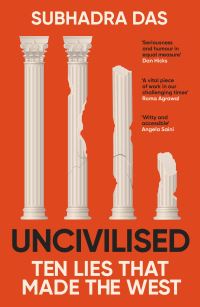
Taking cues from Greek philosophy and honed in the Enlightenment, certain notions about humanity and human society grew into the tenets we live by, and we haven’t questioned them a great deal since. But isn’t it time we asked who really benefits from the values at the core of our society? How much truth lies in a science that conjured up ‘race’? Who do laws and nations really protect? Why does it feel like time is money? What even is ‘art’? And the real question – is the West really as ‘civilised’ as it thinks it is? This book will put everything back on the table and ask listeners to reconsider what they thought they knew about civilisation. Taking 10 core values of Western Civilisation in turn, it will examine the root of the idea, how it developed, and how it’s impacted the way we live.
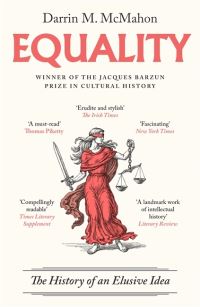
Equality is in crisis. Our world is filled with soaring inequalities, spanning wealth, race, identity, and nationality. Yet how can we strive for equality if we don’t understand it? As much as we have struggled for equality, we have always been profoundly sceptical about it. How much do we want, and for whom? Darrin McMahon’s ‘Equality’ is the definitive intellectual history, tracing equality’s global origins and spread from the dawn of humanity through the Enlightenment to today.

We all notice when the poor get poorer: when there are more rough sleepers and food bank queues start to grow. But if the rich become richer, there is nothing much to see in public and, for most of us, daily life doesn’t change. Or at least, not immediately. In this eye-opening intervention, philosopher and economist Ingrid Robeyns exposes the true extent of our wealth problem, which has spent the past 50 years silently spiralling out of control. In moral, political, economic, social, environmental and psychological terms, she shows, extreme wealth is not only unjustifiable but harmful to us all – the rich included. In place of our current system, Robeyns offers a breathtakingly clear alternative: limitarianism. The answer to so many of the problems posed by neoliberal capitalism – and the opportunity for a vastly better world – lies in placing a hard limit on the wealth that any one person can accumulate.
No products in the basket.
Notifications