Showing all 7 resultsSorted by latest
-
£30.00
A new, narrative history of the Renaissance that takes in the whole of Europe and its global context, written by one of the UK’s foremost art critics and respected writers on art. What was the ‘Renaissance’? In the nineteenth century this flowering of creativity and thought was celebrated as the birth of the modern world. Today many historians are sceptical about its very existence. ‘Earthly Delights’ rekindles the Renaissance as a seismic change in European mentalities, in a panoramic history that encompasses Florence and Bruges, London and Nuremberg.
-
£25.00
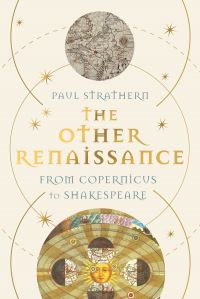
It is generally accepted that the European Renaissance began in Italy. However, a historical transformation of similar magnitude also took place in northern Europe at the same time. This ‘other Renaissance’ was initially centred on the city of Bruges in Flanders (modern Belgium), but its influence was soon being felt in France, the German states, England, and even in Italy itself. Following a sequence of major figures, including Copernicus, Gutenberg, Luther, Catherine de Medici, Rabelais, van Eyck and Shakespeare, Paul Strathern tells the fascinating story of how this ‘other Renaissance’ played as significant a role as the Italian renaissance in bringing our modern world into being.
-
£9.99
Atmospheric and suspenseful, and filled with the famous artists of the era, ‘The Colour Storm’ is an intoxicating story of art and ambition, love and obsession in Renaissance Venice – capturing a moment of artistic invention that echoes through the centuries.
-
£12.00
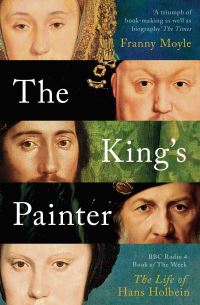
The first illustrated biography of Hans Holbein, the painter who depicted some of the most powerful people of the early sixteenth century, in three decades.
-
£12.99
When Hisham Matar was 19 years old he came across the Sienese School of painting for the first time. In the year in which Matar’s life was shattered by the disappearance of his father the work of the great artists of Siena seemed to offer him a sense of hope. Over the years since then, Matar’s feelings towards these paintings would deepen and, as he says, ‘Siena began to occupy the sort of uneasy reverence the devout might feel towards Mecca or Rome or Jerusalem’. ‘A Month in Siena’ is the encounter, 25 years later, between the writer and the city he had worshipped from afar. It is a dazzling evocation of an extraordinary place and its effect on the writer’s life. It is an immersion in painting, a consideration of grief and a profoundly moving contemplation of the relationship between art and the human condition.
-
£16.99
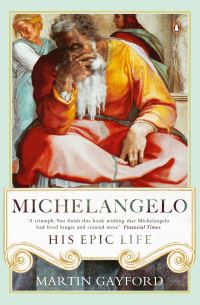
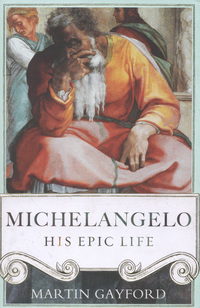
At 31, Michelangelo was considered the finest artist in Italy, perhaps the world; long before he died at almost 90 he was widely believed to be the greatest sculptor or painter who had ever lived (and, by his enemies, to be an arrogant, uncouth, swindling miser). For decade after decade, he worked near the dynamic centre of events: the vortex at which European history was changing from Renaissance to Counter Reformation. Few of his works – including the huge frescoes of the Sistine Chapel Ceiling, the marble giant David and the Last Judgment – were small or easy to accomplish. Like a hero of classical mythology – such as Hercules, whose statue Michelangelo carved in his youth – he was subject to constant trials and labours. Martin Gayford describes what it felt like to be Michelangelo Buonarroti, and how he transformed forever our notion of what an artist could be.
-
£30.00
This is a new biography of Michelangelo by Martin Gayford, the acclaimed author of ‘Constable in Love’ and ‘The Yellow House’.