Showing 33–40 of 40 resultsSorted by latest
-
£22.00
In this keenly awaited new collection, Zadie Smith brings her unique skills as an essayist to bear on a range of subjects which have captured her attention in recent years. She takes an exhilaratingly close look at artists Toyin Ojih Odutola and Celia Paul. She invites us along to the movies, to see and to think about Tar, and to Glastonbury to witness the ascendance of Stormzy. She asks us to look again at the young Michael Jackson and to mourn with her the passing of writers Joan Didion, Martin Amis, Hilary Mantel, Philip Roth and Toni Morrison. And she shows us once again her unrivalled ability to think through critically and humanely some of the most urgent preoccupations and tendencies of our troubled times.
-
£20.00
A courageous way forward for the world’s most intractable conflict
-
£10.99
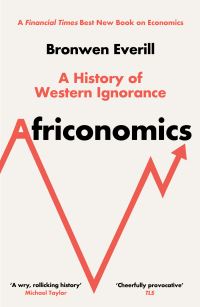
‘A historically insightful read’Financial Times
‘A wry, rollicking, and provocative history’ Michael Taylor, author of The Interest
‘A thought-provoking analysis of Africa’s relationship with economic imperialism’ Astrid Madimba and Chinny Ukata, authors of It’s A Continent
-
£25.00
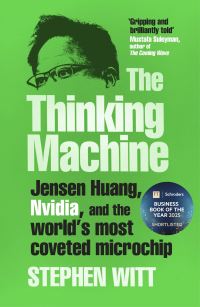
This is a riveting investigative account of Nvidia, the tech company that has exploded in value for its artificial intelligence computing hardware, and Jensen Huang, Nvidia’s charismatic, uncompromising CEO.
-
£10.99
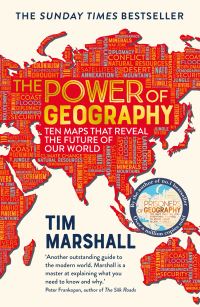
Tim Marshall’s ‘Prisoners of Geography’ showed how every nation’s choices are limited by mountains, rivers, seas, and concrete. Since then, the geography hasn’t changed, but the world has. In this revelatory new book, Marshall takes us into ten regions that are set to shape global politics and power. Find out why the Earth’s atmosphere is the world’s next battleground; why the fight for the Pacific is just beginning; and why Europe’s next refugee crisis is closer than it thinks. In ten chapters covering Australia, The Sahel, Greece, Turkey, the UK, Iran, Ethiopia, Saudi Arabia, Spain and Space, delivered with Marshall’s trademark wit and insight, this is a lucid and gripping exploration of the power of geography to shape humanity’s past, present, and future.
-
£10.99
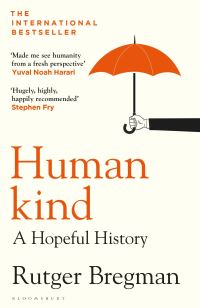
It’s a belief that unites the left and right, psychologists and philosophers, writers and historians. It drives the headlines that surround us and the laws that touch our lives. And its roots sink deep into Western thought: from Machiavelli to Hobbes, Freud to Pinker, the tacit assumption is that humans are bad. Humankind makes the case for a new argument: that it is realistic, as well as revolutionary, to assume that people are good. When we think the worst of others, it brings out the worst in our politics and economics too. In his long-awaited second book, international-bestselling author Rutger Bregman shows how believing in human kindness and altruism can be a new way to think – and act as the foundation for achieving true change in our society. It is time for a new view of human nature.
-
£16.99
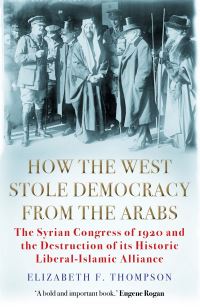
When Europe’s Great War engulfed the Ottoman Empire, Arab nationalists rose in revolt against the Turks. The British supported the Arabs’ fight for an independent state and sent an intelligence officer, T.E. Lawrence, to join Prince Faisal, leader of the Arab army and a descendant of the Prophet. In October 1918, Faisal, Lawrence and the Arabs victoriously entered Damascus, where they declared a constitutional government in an independent Greater Syria. At the Paris Peace Conference, Faisal won the support of President Woodrow Wilson, who sent an American commission to Syria to survey the political aspirations of its people. However, other Entente leaders at Paris – and later San Remo – schemed against the Arab democracy, which they saw as a threat to their colonial rule.
-
£12.99
With ‘Fire and Fury’, Michael Wolff defined the first phase of the Trump administration; now, in ‘Siege’, he has written an equally essential and explosive book about a presidency that is under fire from almost every side. A fresh narrative that begins just as Trump’s second year as president is getting underway and ends with the delivery of the Mueller report, this book reveals an administration that is perpetually beleaguered by investigations and a president who is increasingly volatile, erratic and exposed.