Showing 49–60 of 101 resultsSorted by latest
-
£10.99
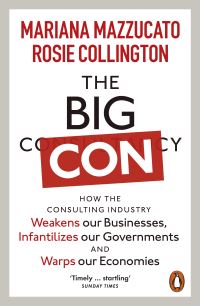
‘The Big Con’ describes the confidence trick the consulting industry performs in contracts with hollowed-out and risk-averse governments and shareholder value-maximizing firms. To make matters worse, our best and brightest graduates are often redirected away from public service into consulting. In all these ways, the Big Con weakens our businesses, infantilises our governments and warps our economies. Mazzucato and Collington expertly debunk the myth that consultancies always add value to the economy. With a wealth of original research, they argue brilliantly for investment and collective intelligence within all organisations and communities, and for a new system in which public and private sectors work innovatively for the common good. We must recalibrate the role of consultants and rebuild economies and governments that are fit for purpose.
-
£25.00
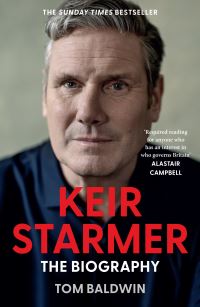
‘The first serious and consistently readable biography of Starmer?It is a wonder that he has said so much to Baldwin’ Patrick Maguire, The Times
‘Required reading for anyone who has an interest in who governs Britain’ ALASTAIR CAMPBELL
-
£25.00
We all notice when the poor get poorer: when there are more rough sleepers and food bank queues start to grow. But if the rich become richer, there is nothing much to see in public and, for most of us, daily life doesn’t change. Or at least, not immediately. In this eye-opening intervention, philosopher and economist Ingrid Robeyns exposes the true extent of our wealth problem, which has spent the past 50 years silently spiralling out of control. In moral, political, economic, social, environmental and psychological terms, she shows, extreme wealth is not only unjustifiable but harmful to us all – the rich included. In place of our current system, Robeyns offers a breathtakingly clear alternative: limitarianism. The answer to so many of the problems posed by neoliberal capitalism – and the opportunity for a vastly better world – lies in placing a hard limit on the wealth that any one person can accumulate.
-
£10.99
Meet the most powerful leader in the world. Chinese premier Xi Jinping graces our television screens and news headlines on a regular basis. But even after a decade in power, he remains shrouded in mystery.From growing up with a father purged in Mao’s Cultural Revolution and his mission to eradicate poverty, to his persecution of Uyghur Muslims and paranoia about being likened to Winnie-the-Pooh, Xi Jinping is a man obscured by caricatures. In this short, essential primer, historian and writer Michael Dillon unveils the character of Xi Jinping – arguably the world’s most powerful man – to truly understand his grip on China, what he wants and how the West gets him wrong. But this is not just the story of Xi; this is the story of today’s largest economic powerhouse, which dives into the crux of the issue – what does Xi’s leadership of China mean for the rest of the world, and what will he do next?
-
£7.99
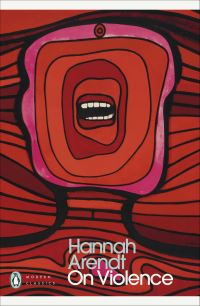
Written in 1970, with the Holocaust and Hiroshima still fresh in recent memory, the war in Vietnam raging and the streets of Europe and America seething with student protest, Hannah Arendt’s now classic work offered a startling dissection of violence in the 20th century: its nature and causes, its place in politics and war, its role in the modern age. Combining theory and lucid historical analysis, Arendt argues that violence and power are ultimately incompatible, and that one fills the vacuum created by the other – an insight which continues to offer a valuable framework for understanding the chaos of our own times.
-
£10.99
‘The Russo-Ukrainian War’ is the comprehensive history of a conflict that has burned since 2014, and that, with Russia’s attempt to seize Kyiv, exploded a geo-political order that had been cemented since the end of the Cold War. With an eye for the gripping detail on the ground, both in the halls of power and down in the trenches, as well as a keen sense of the grander sweep of history, Serhii Plokhy traces the origins and the evolution of the conflict, from the collapse of the Russian empire to the rise and fall of the USSR and on to the development in Ukraine of a democratic politics. Based on decades of research and his unique insight into the region, he argues that Ukraine’s defiance of Russia, and the West’s demonstration of unity and strength, has presented a profound challenge to Putin’s Great Power ambition, and further polarised the world along a new axis.
-
£10.99
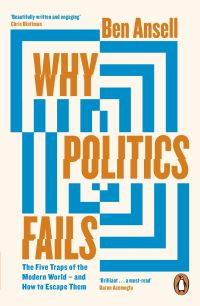
Drawing on examples from Ancient Greece through Brexit and using his own award-winning research – on how democracy is more likely to thrive under high inequality, for instance – Oxford professor Ben Ansell explains the cul-de-sac of modern politics – and how we can make it better. Understanding these traps helps us escape or avoid them altogether, in ways small to large, ultimately showing how we can all thrive in an imperfect world.
-
£12.99
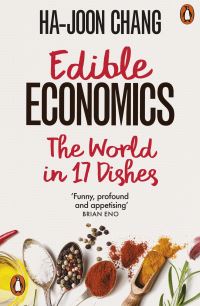
For decades, a single free market philosophy has dominated global economics. But this is bland and unhealthy – like British food in the 1980s, when bestselling author and economist Ha-Joon Chang first arrived in the UK from South Korea. Just as eating a wide range of cuisines contributes to a more interesting and balanced diet, so too is it essential we listen to a variety of economic perspectives. In ‘Edible Economics’, Chang makes challenging economic ideas more palatable by plating them alongside stories about food from around the world. Structuring the book as a series of menus, Chang uses histories behind familiar food items – where they come from, how they are cooked and consumed, what they mean to different cultures – to explore economic theory.
-
£14.99
The modern era saw the emergence of individuals who had command over a terrifying array of instruments of control, persuasion and death. Whole societies were re-shaped and wars fought, often with a merciless contempt for the most basic norms. At the summit of these societies were leaders whose personalities had somehow given them the ability to do whatever they wished. Ian Kershaw’s book is a compelling, lucid and challenging attempt to understand these rulers, whether operating on the widest stage (Lenin, Stalin, Hitler, Mussolini) or with a more national impact (Tito, Franco). What was it about these leaders and the times they lived in that allowed them such untrammelled and murderous power? And what brought that era to an end?
-
£9.99
Adam Fleming introduces and explains the history, key ideas and tools of democracy developed by some of the world’s greatest thinkers – spanning from the ancient Greeks to the present day. From the right to vote to the monarchy, viral politics to Brexit, ’50 Democracy Ideas You Really Need to Know’ is a complete introduction to the most important democracy ideas throughout history.
-
£18.99
For centuries, British identity has been shaped by ideas of exceptionalism and grandeur. Yet its democracy is failing. Minority governments elected under a deeply unrepresentative first-past-the-post system have delivered wounding blows to the country’s economy and international standing. This book explores the constitutional and structural failures at the heart of this political system. It sheds light on a culture of lies, mistrust and corruption. It reveals fundamental flaws in core institutions, including the House of Lords and the House of Commons. It draws on events such as the MP expenses scandal, Brexit, ‘Partygate’, and the farcical premiership of Liz Truss, symptoms of a government in crisis. But it also looks ahead, offering practical solutions and a positive outlook, and asks the question: what can we do to build a better future?
-
£16.99
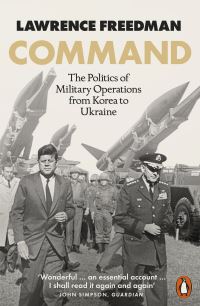
Throughout history, the concept of command – as both a way to achieve objectives and as an assertion of authority – has been essential to military action and leadership. But, as Sir Lawrence Freedman shows, it is also deeply political. Military command has been reconstructed and revolutionized since the Second World War by nuclear warfare, small-scale guerrilla land operations and cyber interference. Freedman takes a global perspective, systematically investigating its practice and politics since 1945 through a wide range of conflicts from the French Colonial Wars, the Cuban Missile Crisis and the Bangladesh Liberation War to North Vietnam’s Easter Offensive of 1972, the Falklands War, the Iraq War and Russia’s wars in Chechnya and Ukraine.