Counting
£12.99WHAT DOES IT MEAN TO COUNT? WHY ARE HUMANS THE ONLY SPECIES ON EARTH THAT CAN DO IT? WHERE DID COUNTING COME FROM? HOW HAS IT SHAPED SOCIETIES ALONG THE WAY? AND WHY DOES IT MATTER?
Subtotal: £10.99
Showing all 9 resultsSorted by latest
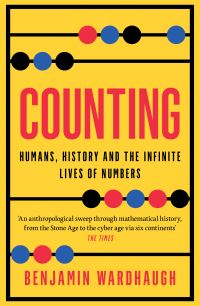
WHAT DOES IT MEAN TO COUNT? WHY ARE HUMANS THE ONLY SPECIES ON EARTH THAT CAN DO IT? WHERE DID COUNTING COME FROM? HOW HAS IT SHAPED SOCIETIES ALONG THE WAY? AND WHY DOES IT MATTER?
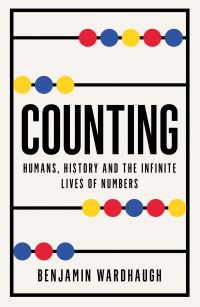
WHAT DOES IT MEAN TO COUNT? WHY ARE HUMANS THE ONLY SPECIES ON EARTH THAT CAN DO IT? WHERE DID COUNTING COME FROM? HOW HAS IT SHAPED SOCIETIES ALONG THE WAY? AND WHY DOES IT MATTER?
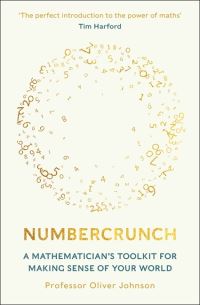
In our hyper-modern world, we are bombarded with more facts, stats and information than ever before. So, what can we grasp hold of to make sense of it all? Oliver Johnson reveals how mathematical thinking can help us understand the myriad data all around us.
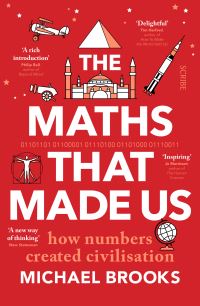
Quadratic equations, Pythagoras’ theorem, imaginary numbers, and pi – you may remember studying these at school, but did anyone ever explain why? Never fear – bestselling science writer, and your new favourite maths teacher, Michael Brooks, is here to help. In ‘The Maths That Made Us’, Brooks reminds us of the wonders of numbers: how they enabled explorers to travel far across the seas and astronomers to map the heavens; how they won wars and halted the HIV epidemic; how they are responsible for the design of your home and almost everything in it, down to the smartphone in your pocket. His clear explanations of the maths that built our world, along with stories about where it came from and how it shaped human history, will engage and delight.
Even if you stick to the whole numbers, there are a lot to choose from – an infinite number in fact. Throw in decimal fractions and infinity suddenly gets an awful lot bigger (is that even possible?) And then there are the negative numbers, the imaginary numbers, the irrational numbers like pi which never end. It literally never ends. The world of numbers is indeed strange and beautiful. Among its inhabitants are some really notable characters – pi, e, the ‘imaginary’ number i and the famous golden ratio to name just a few. Prime numbers occupy a special status. Zero is very odd indeed: is it a number, or isn’t it? This book takes a tour of this mind-blowing but beautiful realm of numbers and the mathematical rules that connect them.
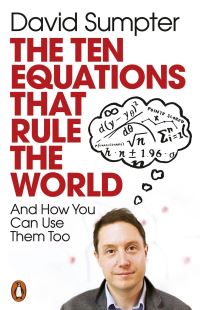
Is there a secret formula for getting rich? For making something a viral hit? For deciding how long to stick with your current job, Netflix series, or even relationship? This book is all about the equations that make our world go round. Ten of them, in fact. They are integral to everything from investment banking to betting companies and social media giants. And they can help you to increase your chance of success, guard against financial loss, live more healthily and see through scaremongering. They are known only by mathematicians – until now. With wit and clarity, mathematician David Sumpter shows that it isn’t the technical details which make these formulas so successful. It is the way they allow mathematicians to view problems from a different angle – a way of seeing the world that anyone can learn.
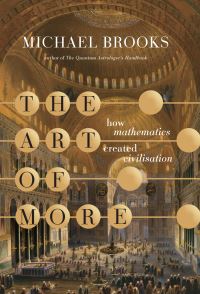
Bestselling science writer Michael Brooks takes us on a fascinating journey through the history of civilisation, as he explains why maths is fundamental to our understanding of the world. The untrained brain isn’t wired for maths; beyond the number 3, it just sees ‘more’. So why bother learning it at all? You might remember studying geometry, calculus, and algebra at school, but you probably didn’t realise – or weren’t taught – that these are the roots of art, architecture, government, and almost every other aspect of our civilisation. The mathematics of triangles enabled explorers to travel far across the seas and astronomers to map the heavens. Calculus won the Allies the Second World War and halted the HIV epidemic. And imaginary numbers, it turns out, are essential to the realities of 21st-century life.
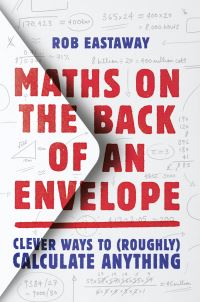
‘Another terrific book by Rob Eastaway’ SIMON SINGH
‘A delightfully accessible guide to how to play with numbers’ HANNAH FRY
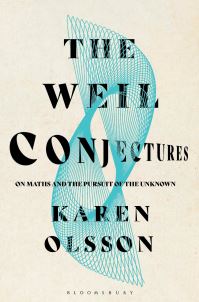
Simone Weil: famous French philosopher, writer, political activist, mystic – and sister to André, one of the most influential mathematicians of the 20th century. For Karen Olsson, who studied mathematics at Harvard only to turn to writing as a vocation, the lives and obsessions of these two extraordinary siblings returned her to the intellectual passions of her youth. When Olsson got hold of the 1940 letters between Simone and André, she discovered that André’s pursuit of his studies became increasingly incomprehensible to his sister, leading to Simone directly questioning him about the value of such rarefied knowledge as it applied to the lived experience. Struck by this conflict, Olsson revisits her own time at university, how she came to be consumed by mathematics, and the unexpected similarities that can be found between two seemingly opposed subjects.
Subtotal: £10.99
Notifications