Showing 1–12 of 14 resultsSorted by latest
-
£12.99
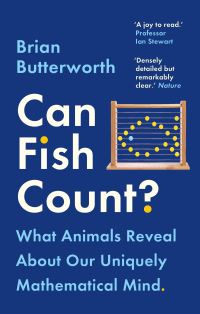
Every pet owner thinks their own dog, cat, fish or hamster is a genius. Pioneering psychologist Brian Butterworth describes the extraordinary numerical feats of all manner of species ranging from primates and mammals to birds, reptiles, fish and insects. Whether it’s lions deciding to fight or flee, frogs competing for mates, bees navigating their way to food sources, fish assessing which shoal to join, or jackdaws counting friends when joining a mob – every species shares an ability to count.
-
£12.99
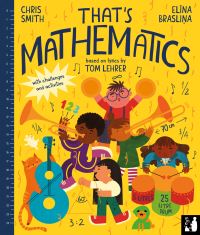
A vibrant, colourful book for young children showing them that maths is useful, interesting, fun and EVERYWHERE! They use it every day when they count, share, play, do sport, make cakes or move to music. Aimed at children from 5 to 8 years, the youngest can enjoy it as a picture book, reading Lehrer’s rhyming song lyrics and looking at Elina BrasliÂna’s joyful illustrations. They will pick up a basic understanding of real-world maths and learn some core maths language along the way. Older children are challenged to ‘Try This’ and ‘Explore This’ by author Chris Smith, who is a maths teacher, musician and all-round maths enthusiast. The activities are designed to deepen their curiosity and knowledge. There are supporting online activities to continue the fun, plus notes for parents to encourage you to get involved and help you discuss topics covered and keep the learning going after the book is closed.
-
£25.00
Picture yourself at a starting point before anything exists – no matter, no cosmos, not even empty space. Your task is to create the universe, but all you have to work with is, quite literally, ‘nothing’. How do you proceed? This is the thought experiment ‘The Big Bang of Numbers’ invites you into, as an original and completely accessible way to appreciate mathematics.
-
£9.99
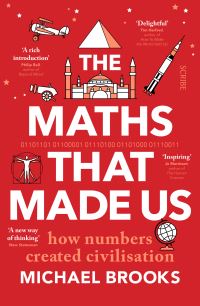
Quadratic equations, Pythagoras’ theorem, imaginary numbers, and pi – you may remember studying these at school, but did anyone ever explain why? Never fear – bestselling science writer, and your new favourite maths teacher, Michael Brooks, is here to help. In ‘The Maths That Made Us’, Brooks reminds us of the wonders of numbers: how they enabled explorers to travel far across the seas and astronomers to map the heavens; how they won wars and halted the HIV epidemic; how they are responsible for the design of your home and almost everything in it, down to the smartphone in your pocket. His clear explanations of the maths that built our world, along with stories about where it came from and how it shaped human history, will engage and delight.
-
£12.99
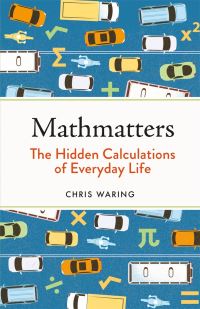
A humorous guide to the hidden calculations that are essential to everything we do.
-
£10.99
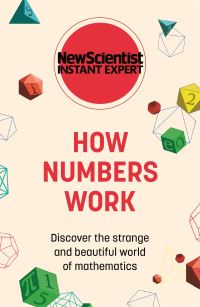
Even if you stick to the whole numbers, there are a lot to choose from – an infinite number in fact. Throw in decimal fractions and infinity suddenly gets an awful lot bigger (is that even possible?) And then there are the negative numbers, the imaginary numbers, the irrational numbers like pi which never end. It literally never ends. The world of numbers is indeed strange and beautiful. Among its inhabitants are some really notable characters – pi, e, the ‘imaginary’ number i and the famous golden ratio to name just a few. Prime numbers occupy a special status. Zero is very odd indeed: is it a number, or isn’t it? This book takes a tour of this mind-blowing but beautiful realm of numbers and the mathematical rules that connect them.
-
£18.99
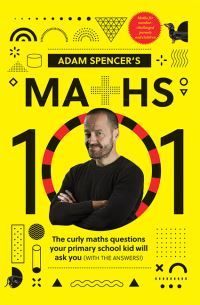
Maths explained for number challenged parents and children
-
£9.99
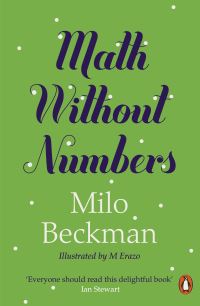
‘Math Without Numbers’ is a vivid and wholly original guide to the three main branches of abstract math – topology, analysis, and algebra – which turn out to be surprisingly easy to grasp. Milo Beckerman upends the conventional approach to mathematics, inviting you to think creatively about shape and dimension, the infinite and infinitesimal, symmetries, proofs, and how these concepts all fit together. How many shapes are there? Is anything bigger than infinity? And can mathematics even be described as ‘true’?
-
£18.99
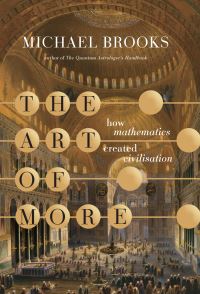
Bestselling science writer Michael Brooks takes us on a fascinating journey through the history of civilisation, as he explains why maths is fundamental to our understanding of the world. The untrained brain isn’t wired for maths; beyond the number 3, it just sees ‘more’. So why bother learning it at all? You might remember studying geometry, calculus, and algebra at school, but you probably didn’t realise – or weren’t taught – that these are the roots of art, architecture, government, and almost every other aspect of our civilisation. The mathematics of triangles enabled explorers to travel far across the seas and astronomers to map the heavens. Calculus won the Allies the Second World War and halted the HIV epidemic. And imaginary numbers, it turns out, are essential to the realities of 21st-century life.
-
£20.00
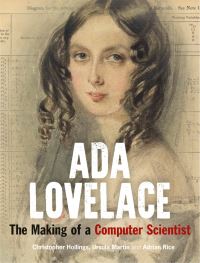
Featuring images of the ‘first programme’ and Lovelace’s correspondence, alongside mathematical models, and contemporary illustrations, this book shows how Ada Lovelace, with astonishing prescience, explored key mathematical questions to understand the principles behind modern computing.
-
£8.99
This book provides your child with a whole year of ready to go activities and support on key Mathematics topics which will be being taught in school from 2014. *Workbooks for home learning or classroom practice *Linked website with additional activities, answers and support for parents. *Developed by teachers.
-
£8.99
This book provides your child with a whole year of ready to go activities and support on key Mathematics topics which will be being taught in school from 2014. *Workbooks for home learning or classroom practice *Linked website with additional activities, answers and support for parents. *Developed by teachers.