Showing all 7 resultsSorted by latest
-
£12.99
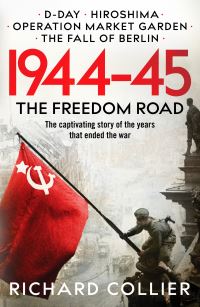
Going into 1944, the Allies knew the tide was turning in their favour. But they still faced a monumental task to get to victory. From the beaches of Normandy on D-Day to those of the Pacific stormed by American marines, from the air drops at Arnhem and the Battle of the Bulge, to the final dropping of the atomic bomb on Hiroshima and Nagasaki, from the sacking of Berlin to the delicate peace that followed, this is a gripping and impeccably researched account of two years that forever changed the world.
-
£12.99
One of the greatest and most terrible years in world history. ‘This war has now assumed the character’, wrote Benito Mussolini, before 1941 was six months old, ‘of a war between two worlds’, and the Italian dictator had rarely predicted more truly. Before the year had ended, following Hitler’s surprise assault on Russia and the Japanese attack on Pearl Harbour, thirty-seven nations were engaged in an all-out war reminiscent of Armageddon, ‘the battle of that great day of God Almighty’. Richard Collier’s narrative spans both this entire, devastating year, as well as the events that led up to it.
-
£12.99
If Hitler had failed in his invasion of Western Europe in 1940 he could well have been assassinated by a group of his senior officers. But he decisively defeated the combined efforts of the British, French, Dutch and Belgian armies in a matter of days. The technique employed was known as Blitzkrieg or Lightning War. Nothing would be the same again. Although strands were clearly apparent by 1918, it was perfected through the interwar years before being deployed with terrifying effect by the Nazis at the outbreak of the Second World War. Eventually, other combatants would employ similar methods and the tide would turn. As well as discussing the developing nature of tactics, fighting vehicles and aircraft from 1918 onwards, the author examines the potent workings of Blitzkrieg in-depth, describing not only its obvious triumphs but also its fatal flaws.
-
£10.99
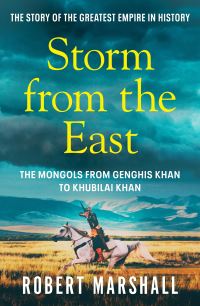
Genghis Khan left an empire more than twice the size of Alexander’s: his successors went on to conquer and govern an area stretching from Korea to the River Danube. How did a band of nomadic herdsmen achieve so much, so fast? Despite these stunning achievements, many writers dismiss the Mongols as just ferocious barbarians. This book sets the record straight. The epic starts in 1206 – when Genghis became master of ‘all the people with felt tents’ and an unknown tribe took the first steps towards world domination – and ends with the empire’s decline and fall, after Khubilai Khan’s triumphant unification with China. Robert Marshall describes their devastating invasions, including that of feudal Europe and Christendom’s clumsy attempts to understand and fend off these legendary warriors.
-
£9.99
From the bestselling author of Normandy ’44 and Sicily ’43 comes the untold story of the Sherwood Rangers. It took a certain type of courage to serve in a tank in World War Two. Encased in steel, surrounded by highly explosive shells, a big and slow-moving target, every crew member was utterly vulnerable to enemy attack from all sides. Living – and dying – in a tank was a brutal way to fight a war. The Sherwood Rangers were one of the great tank regiments. They had learned their trade the hard way, under the burning sun of North Africa, on the battlefields of El Alamein and Alam el Halfa. By the time they landed on Gold Beach on D-Day, they were toughened by experience and ready for combat.
-
£9.99
This is a gripping brutal history, taking us deep into one of the most terrifying and cult-like units of the Second World War. It shows just how far the Nazi’s were willing to go; and the great efforts needed to vanquish them.
-
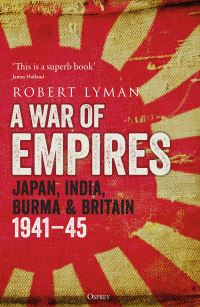
£25.00
In 1941 and 1942 the British and Indian Armies were brutally defeated and Japan reigned supreme in its newly conquered territories throughout Asia. But change was coming. New commanders were appointed, significant training together with restructuring took place, and new tactics were developed. This book expertly retells these coordinated efforts and describes how a new volunteer Indian Army, rising from the ashes of defeat, would ferociously fight to turn the tide of war. But victory did not come immediately. It wasn’t until March 1944, when the Japanese staged their famed ‘March on Delhi’, that the years of rebuilding reaped their reward and after bitter fighting, the Japanese were finally defeated at Kohima and Imphal. This was followed by a series of extraordinary victories culminating in Mandalay in May 1945 and the collapse of all Japanese forces in Burma.