Anaximander
£16.99Carlo Rovelli restores Anaximander to his place in the history of science by carefully reconstructing his theories from what is known to us and examining them in their historical and philosophical contexts.
 Ken Prep World Book Day: There's a Tiger on the Train
1 × £6.99
Ken Prep World Book Day: There's a Tiger on the Train
1 × £6.99  Ken Prep World Book Day: The Silver Shadow
1 × £11.99
Ken Prep World Book Day: The Silver Shadow
1 × £11.99  Ken Prep World Book Day: Wands Away
1 × £6.99
Ken Prep World Book Day: Wands Away
1 × £6.99 Subtotal: £25.97
Showing 25–36 of 61 resultsSorted by latest
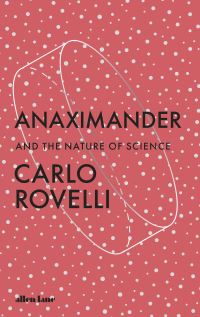
Carlo Rovelli restores Anaximander to his place in the history of science by carefully reconstructing his theories from what is known to us and examining them in their historical and philosophical contexts.
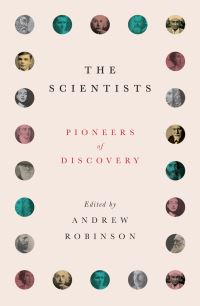
This title, written by an international team of distinguished scientists, historians of science and science writers, provides an unrivalled account of the lives and personalities behind the greatest scientific breakthroughs of all time, from Galileo and Newton to Einstein and Freud.
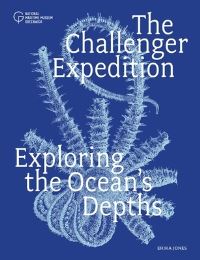
On December 1872, HMS Challenger, especially modified to support a team of civilian scientists, set sail from Portsmouth, England, to begin a round-the-world journey, unique for the scale of its ambition and scope. This book tracks the paths of six objects associated with the Challenger expedition, including the Baillie sounding machine, a starfish, a photographic album and HMS Challenger itself, to reveal the stories of the often hidden work, technologies and international collaboration at the heart of this 19th-century scientific endeavour.

Slime is an ambiguous thing. It exists somewhere between a solid and liquid. It inspires revulsion even while it compels our fascination. It is a both a vehicle for pathogens and the strongest weapon in our immune system. Most of us know little about it and yet it is the substance on which our world turns. Slime exists at the interfaces of all things: between the different organs and layers in our bodies, and between the earth, water, and air in the environment. It is often produced in the fatal encounter between predator and prey, and it is a vital presence in the reproductive embrace between female and male. In this ground-breaking and fascinating book, Susanne Wedlich leads us on a scientific journey through the three billion year history of slime, from the part it played in the evolution of life on this planet to the way it might feature in the post-human future.
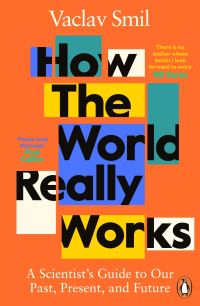
We have never had so much information at our fingertips and yet most of us don’t know how the world really works. This book explains seven of the most fundamental realities governing our survival and prosperity. From energy and food production, through our material world and its globalization, to risks, our environment and its future, ‘How the World Really Works’ offers a much-needed reality check – because before we can tackle problems effectively, we must understand the facts.
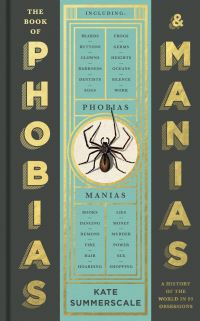
Do you recoil in arachnophobic horror at the sight of a spider – or twitch with nomophobia when you misplace your mobile phone? Do your book-buying habits verge on bibliomania? Perhaps you find yourself mired in indecision and uncertainty? (Would it be reassuring to give this a name: aboulomania?) Our phobias and manias are contradictory and multiple: deeply intimate, yet forged by the times we live in – the commonest form of anxiety disorder, but rarely given a formal diagnosis. Plunge into this rich, surprising and fascinating A-Z compendium to discover how our fixations have taken shape, from pre-history to the present day, as award-winning author Kate Summerscale deftly traces the threads between the past and present, the psychological and social, the personal and the political.
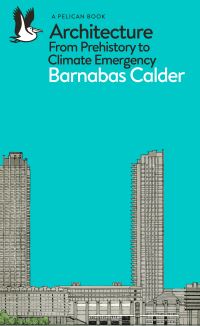
Reducing energy use is the single biggest challenge facing architecture today. From the humblest prehistoric hut to the imposing monuments of Rome or Egypt to super-connected modern airports, buildings in every era and place have been shaped by the energy available for their construction and running. This survey tells the story of our buildings from our hunter-gatherer origins to the age of fossil-fuel dependence, and shows how architecture has been influenced by designers, builders and societies adapting to changing energy contexts. It is a celebration of human ingenuity and creativity, and a timely reminder of the scale of the task ahead in our search for truly sustainable architecture.
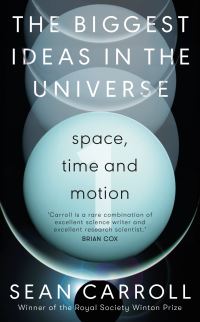
A groundbreaking new series from bestselling author Sean Carroll
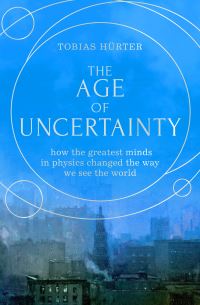
The history of how a group of physicists toppled the Newtonian universe in the early decades of the twentieth century. Marie Curie, Max Planck, Niels Bohr, Werner Heisenberg, Erwin Schrödinger, and Albert Einstein didn’t only revolutionise physics; they redefined our world and the reality we live in. In ‘The Age of Uncertainty’, Tobias Hürter brings to life the golden age of physics and its dazzling, flawed, and unforgettable heroes and heroines.
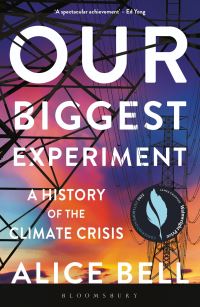
‘Our Biggest Experiment’ tells the story of how the world became addicted to fossil fuels, how we discovered that electricity may be our saviour and how renewable energy is far from a 20th century discovery. Dr Alice Bell cuts through the jargon and the jumble of numbers to present a pacey and approachable telling of how we are getting to grips with what is now the defining issue of our time. She doesn’t sugar-coat the situation – the potential consequences for us and for future generations are genuinely disturbing – but she also makes the very salient point that it is amazing that we noticed it in the first place. The message she gives is ultimately hopeful: harnessing the ingenuity and intelligence that has driven the history of climate change research can mean a more sustainable and bearable future for humanity.
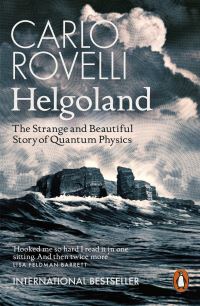
In June 1925, 23-year-old Werner Heisenberg, suffering from hay fever, retreated to a small, treeless island in the North Sea called Helgoland. It was there that he came up with one of the most transformative scientific concepts: quantum theory. Almost a century later, quantum physics has given us many startling ideas: ghost waves, distant objects that seem magically connected to each other, cats that are both dead and alive. Countless experiments have led to practical applications that shape our daily lives. Today our understanding of the world around us is based on this theory. And yet it is still profoundly mysterious. Here, Carlo Rovelli tells the extraordinary story of quantum physics and reveals its deep meaning: a world made of substances is replaced by a world made of relations, each particle responding to another in a never ending game of mirrors.
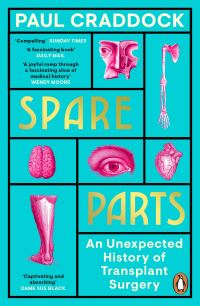
How did an architect help pioneer blood transfusion in the 1660s? Why did eighteenth-century dentists buy the live teeth of poor children? And what role did a sausage skin and an enamel bath play in making kidney transplants a reality? We think of transplant surgery as one of the medical wonders of the modern world but transplant surgery is as ancient as the pyramids, with a history more surprising than we might expect. Paul Craddock takes us on a journey – from sixteenth-century skin grafting to contemporary stem cell transplants – uncovering stories of operations performed by unexpected people in unexpected places.
Ken Prep World Book Day: There's a Tiger on the Train
1 × £6.99 Ken Prep World Book Day: The Silver Shadow
1 × £11.99 Ken Prep World Book Day: Wands Away
1 × £6.99 Subtotal: £25.97
Notifications