Showing 73–84 of 205 resultsSorted by latest
-
£16.99
Solve intriguing and challenging puzzles based on the world-renowned British Museum collection. The Rosetta Stone, Egyptian hieroglyphs, Assyrian reliefs, the Lewis Chessmen: many mysteries of the past are found within the walls of the British Museum, home to some of the most magnificent treasures in the world. Now you can learn more about its famous artefacts as you work your way through this beautifully designed, generously illustrated puzzle book.
-
£16.99
Have you ever wondered who the third man on the moon was? Did you know that Dick Whittington really was the medieval Mayor of London? Why was a pigeon a hero to the American army? What’s the difference between a dolmen and a barrow? Who were the Wu, Wei and Shu Han? Was Napoleon really small? Who said ‘Pardon me, sir, I didn’t mean to’ just before they were executed? When was the oldest known shark attack?The answers to all these questions and so much more are contained within this wonderful miscellany of historical facts, figures and fascinating finds which will enthral, entertain and inform everyone who loves history and wants to know more about more.
-
£25.00
A captivating biography of two famous women whose sons, Winston Churchill and Franklin D Roosevelt, would change the course of the 20th century by award-winning historian Charlotte Gray.
Â
-
£16.99
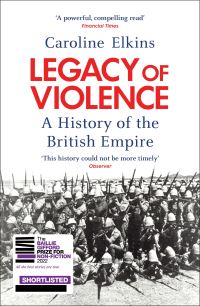
Sprawling across a quarter of the world’s land mass and claiming nearly 500 colonial subjects, Britain’s empire was the largest empire in human history. For many, it epitomised our nation’s cultural superiority, but what legacy have we delivered to the world? Spanning more than 200 years of history, Caroline Elkins reveals evolutionary and racialised doctrines that espoused an unrelenting deployment of violence to secure and preserve British imperial interests. She outlines how ideological foundations of violence were rooted in Victorian calls for punishing indigenous peoples who resisted subjugation, and how over time, this treatment became increasingly institutionalised.
-
£10.99
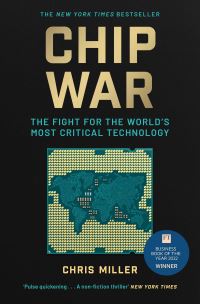
Why control of the microchip industry has been the driving force of Western economic and military success, and the potential threats posed by China’s actions
-
£25.00
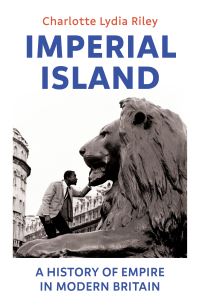
After World War II, Britain’s overseas empire disintegrated. But over the next seventy years, empire came to define Britain as never before. From immigration and race riots, to the Suez Crisis and the Falklands War, from the simplistic moral equation of Band Aid to the invasion of Iraq, the imperial mindset has dominated Britain’s relationship with itself and the world. The ghosts of empire are there, too, in the tragedy of Stephen Lawrence and in the response to radical Islam, in the opening ceremony of the 2012 Olympics and in scandal of the Windrush deportations – and of course in Brexit. Drawing on a mass of original research into the thoughts and feelings of the British people, pop culture, sport and media, this book tells a story of people on the move and of people trapped in the past, of the end of empire and the birth of multiculturalism, a chronicle of violence and a testament to togetherness.
-
£10.99
An acclaimed expert on violence and seasoned peacebuilder explains the five reasons why conflict (rarely) blooms into war, and how to interrupt that deadly process. It’s easy to overlook the underlying strategic forces of war, to see it solely as a series of errors, accidents, and emotions gone awry. It’s also easy to forget that war shouldn’t happen-and most of the time it doesn’t. Around the world there are millions of hostile rivalries, yet only a tiny fraction erupt into violence. Too many accounts of conflict forget this. With a counterintuitive approach, Blattman reminds us that most rivals loathe one another in peace. That’s because war is too costly to fight.
-
£25.00
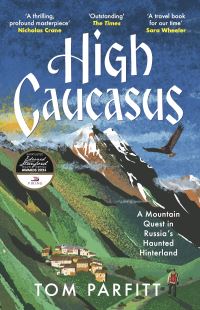
On the 1 September 2004, at the Beslan siege in Russia when Chechen terrorists took more than 1,000 people captive at celebrations held to mark the first day of the school year. Lasting three days, the siege reached a bloody climax when two bombs exploded inside the school and Russian troops stormed the building, sparking a fire in the gymnasium where the captives were held. In the chaos, 334 hostages, more than half of them children, died. Never a war correspondent, Tom was emotionally pulverised, and his solution was to turn back to his lifelong love of walking, to a nature cure of sorts. Having long loved the Caucasus, he also wanted to understand why the mountain peoples there, people like the Chechens, were so angry at Russia. That was how Tom came to walk 1,000 miles across the North Caucasus.
-
£35.00
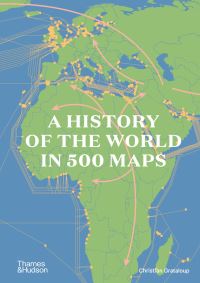
Trace the history of the world in over 500 easy-to-follow maps, from the dawn of humanity to the present day. Organized chronologically, ‘A History of the World in 500 Maps’ tells a clear, linear story, bringing together themes as diverse as religion, capitalism, warfare, geopolitics, popular culture and climate change. Meticulously rendered maps chart the sequence of broad historical trends, from the dispersal of our species across the globe to the colonizing efforts of imperial European powers in the 18th century, as well as exploring moments of particular significance in rich detail.
-
£20.00
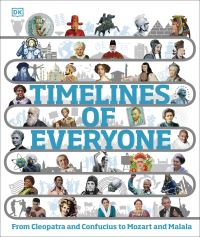
Get the inside track on the incredible lives of history’s must-know names: from Shakespeare to Oprah Winfrey, and Anne Frank to Julius Caesar. This book boasts more than 150 visual timelines, covering a diverse array of kings and queens, humanitarians, scientists, inventors, explorers, activists, writers, artists, and more, from all over the globe. It breathes fresh life into the biographies of the people you thought you knew, and unearths many stories from previously ignored or unheard voices.
-
£22.00
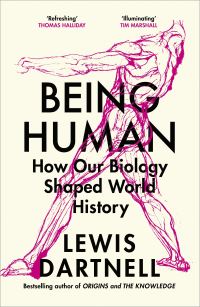
Powerful yet dextrous, instinctive yet thoughtful, we are expert communicators and innovators. Our exceptional abilities have created the civilisation we know today. But we’re also deeply flawed. Our bodies break, choke and fail, whether we’re kings or peasants. Diseases thwart our boldest plans. Our psychological biases have been at the root of terrible decisions in both war and peacetime. This extraordinary contradiction is the essence of what it means to be human – the sum total of our frailties and our faculties. And history has played out in the balance between them. Now, Lewis Dartnell tells our story through the lens of this unique, capricious and fragile nature. He explores how our biology has shaped our relationships, our societies, our economies and our wars, and how it continues to challenge and define our progress.
-
£30.00
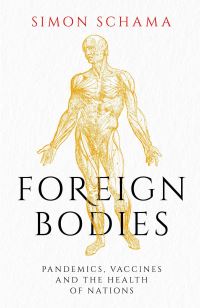
An epic story of humanity’s struggle against pandemics from the renowned historian and broadcaster