Showing 133–144 of 205 resultsSorted by latest
-
£10.99
In very recent times humanity has learnt a vast amount about the universe, the past, and itself. But through our remarkable successes in acquiring knowledge we have learned how much we have yet to learn: the science we have, for example, addresses just 5% of the universe; pre-history is still being revealed, with thousands of historical sites yet to be explored; and the new neurosciences of mind and brain are just beginning. Bestselling polymath and philosopher A.C. Grayling seeks to answer them in three crucial areas at the frontiers of knowledge: science, history, and psychology. In each area he illustrates how each field has advanced to where it is now, from the rise of technology to quantum theory, from the dawn of humanity to debates around national histories, from ancient ideas of the brain to modern theories of the mind.
-
£10.99
Pilgrimage, a global ritual embraced by all faiths, is one of the most enduring traits in our human story. In this compelling history, Peter Stanford reflects on the reasons people have walked along the same sacred paths across the ages. How do the experiences of the first pilgrims to Jerusalem, Mecca and Santiago de Compostela compare to the millions of people who embark upon life-changing physical and spiritual journeys today? And why do we still feel compelled to walk, stop and think about our lives? The book explores sacred landscapes across the world, the Basilica of Our Lady of Guadalupe in Mexico City, to the monolithic rock-cut churches of Lalibela, Ethiopia and the riverbanks of the Kumbh Mela in India. These journeys are to places of healing and reflection, but also to sites of danger and even violence, at crossroads where different political and religious tensions meet.
-
£9.99
Why is it easy to hate and difficult to love? When societies fracture into warring tribes, we demonise those who oppose us. We tear down our statues, forgetting that what begins with the destruction of statues, often leads to the killing of people. Blending history, philosophy and psychology, A History of Love and Hate in 21 Statues is a compelling exploration of identity and power. This remarkable book spans every continent, religion and era, through the creation and destruction of 21 statues from Hatshepsut and the Buddhas of Bamiyan to Mendelssohn, Edward Colston and Frederick Douglass.
-
£12.99
This was a time of blitzkrieg and the Blitz; of the Battle of Britain and Dunkirk. From the fighting in Finland to the destruction of Coventry, from the sinking of the French fleet in Oran to the invasion of Norway, this is history at its most extraordinary and engaging. By recounting major episodes from the viewpoint of those actually involved, Collier provides enlightening glimpses of just what war represented to both the great and to the unknown, and reveals that while 1940 was a year of incredible folly, it was also a time of inestimable bravery.
-
£25.00
We are told that modern science was invented in Europe, the product of great minds like Nicolaus Copernicus, Isaac Newton, Charles Darwin and Albert Einstein. But this is wrong. Science is not, and has never been, a uniquely European endeavour. Copernicus relied on mathematical techniques borrowed from Arabic and Persian texts. When Newton set out the laws of motion, he relied on astronomical observations made in Asia and Africa. When Darwin was writing On the Origin of Species, he consulted a sixteenth-century Chinese encyclopaedia. And when Einstein was studying quantum mechanics, he was inspired by the Bengali physicist, Satyendra Nath Bose. ‘Horizons’ pushes beyond Europe, exploring the ways in which scientists from Africa, America, Asia and the Pacific fit into the history of science, and arguing that it is best understood as a story of global cultural exchange.
-
£30.00
Sprawling across a quarter of the world’s land mass and claiming nearly 500 colonial subjects, Britain’s empire was the largest empire in human history. For many, it epitomised our nation’s cultural superiority, but what legacy have we delivered to the world? Spanning more than 200 years of history, Caroline Elkins reveals evolutionary and racialised doctrines that espoused an unrelenting deployment of violence to secure and preserve British imperial interests. She outlines how ideological foundations of violence were rooted in Victorian calls for punishing indigenous peoples who resisted subjugation, and how over time, this treatment became increasingly institutionalised.
-
£25.00
The story of our Universe, from its beginning in the first milliseconds of the Big Bang right up to our present moment and beyond, told in a gripping narrative. Everyone knows astronomers use telescopes to peer into distant space. They also use them as a time machine to look back into the past. In this book, Paul Murdin lays out the entire history of the Universe backwards along a line of sight through space, from here on Earth into the distance, leading us step by step through the deep history of time and space.
-
£20.00
Set in Venice, 1522, this is ‘eye-witness history’ telling the story of Suleyman’s rise to power in the 16th century. Sensitive intelligence arrives from the east confirming the European powers’ greatest fear: the vastly rich Ottoman Sultan has amassed all he needs to wage total war – and his sights are set on Rome. With Christendom divided, Suleyman the Magnificent has his hand on their entrails.
-
£10.99
Can Donald Trump really build that wall? What does Brexit mean for Ireland’s border? And what would happen if Elon Musk declared himself president of the Moon? In ‘Border Wars’, Professor Klaus Dodds takes us on a journey into the geopolitical conflict of tomorrow in an eye-opening tour of the world’s best-known, most dangerous and most unexpected border conflicts from the Gaza Strip to the space race. Along the way, we’ll discover just what border truly mean in the modern world: how are they built; what do they mean for citizens and governments; how do they help understand our political past and, most importantly, our diplomatic future?
-
£9.99
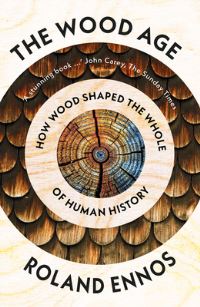
When our ancestors came down from the trees, they brought the trees with them and remade the world.
‘A stunning book on the incalculable debt humanity owes wood?’ John Carey, The Sunday Times
-
£25.00
Great cities are complex, chaotic, and colossal. These are cities that dominate the world stage and define eras; where ideas flourish, revolutions are born and history is made. Through ten unique cities, from the founding of ancient capitals to buzzing modern megacities, Paul Strathern explores how urban centres lead civilisation forward, enjoying a moment of glory before passing on the baton.We journey back to discover Babylonian mathematics, Athenian theatre and intellectual debate, and Roman construction that has lasted millennia.
-
£9.99
From the city sundials of ancient Rome to the era of the smartwatch, clocks have been used throughout history to wield power, make money, govern citizens and keep control. Sometimes, also with clocks, we have fought back. In this book, time expert David Rooney tells the story of timekeeping, and how it continues to shape our modern world. In twelve chapters, demarcated like the hours of time, we meet the greatest inventions in horological history, from medieval water clocks to monumental sundials, and from coastal time signals to satellites in Earth’s orbit.