Showing 1–12 of 26 resultsSorted by latest
-
£10.99
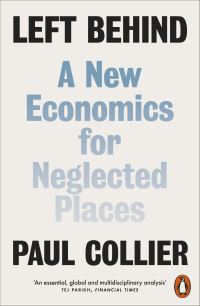
Left behind places can be found in prosperous countries – from South Yorkshire, integral to the industrial revolution and now England’s poorest county, to Barranquilla, once Colombia’s portal to the Caribbean and now struggling. More alarmingly, the poorest countries in the world are diverging further from the rest of humanity. Why have these places fallen further behind? And what can we do about it? World-renowned development economist Paul Collier has spent his life working in neglected communities. In this book he offers his candid diagnosis of why some regions and countries are falling further behind, and a new vision for how they can catch up. Collier lays the blame for widening inequality on stale economic orthodoxies that prioritize market forces and centralized bureaucracies like the UK Treasury.
-
£10.99
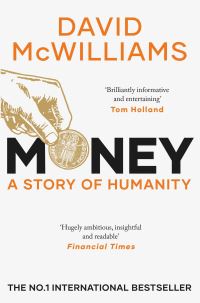
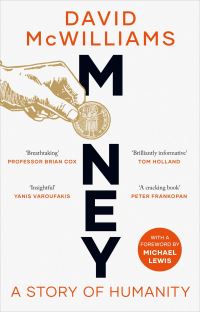
For readers of SAPIENS and Yanis Varoufakis, the definitive story of money and how it shaped humankind from influential global economist David McWilliams
Â
-
£22.00
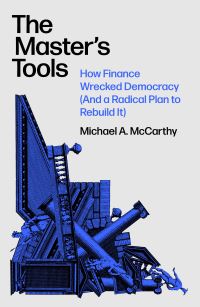
Finance serves the rich and powerful. We need to democratize it.
-
£12.99
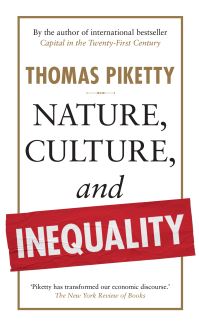
Thomas Piketty explores how social inequality manifests itself very differently depending on the society and epoch in which it arises. History and culture play a central role, inequality being strongly linked to various socio-economic, political, civilisational, and religious developments. So it is culture in the broadest sense that makes it possible to explain the diversity, extent, and structure of the social inequality that we observe every day. Piketty briefly and concisely presents a lively synthesis of his work, taking up such diverse topics as education, inheritance, taxes, and the climate crisis, and provides exciting food for thought for a highly topical debate: Does natural inequality exist?
-
£25.00
Money. The object of our desires. The engine of our genius. Humanity’s greatest invention. Whether we like it or not, our world revolves around money, but we rarely stop to think about it. What is money, where does it come from, and can it run out? What is this substance that drives trade, revolutions and discoveries; inspires art, philosophy and science? In this illuminating, sometimes irreverent, and often surprising journey, economist David McWilliams charts the relationship between humans and money – from a tally stick in ancient Africa to coins in Republican Greece, from mathematics in the medieval Arab world to the French Revolution, and from the emergence of the US dollar right up to today’s cryptocurrency and beyond.
-
£10.99
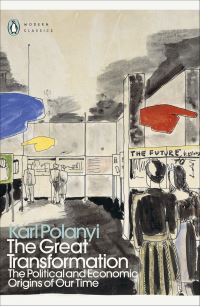
Tracing the history of capitalism in England and beyond, Karl Polanyi’s landmark 1944 classic brilliantly exposed the myth of laissez-faire economics. From the great transformation that occurred during the industrial revolution onwards, he showed, there has been nothing ‘natural’ about the market state. Instead, the economy must always be embedded in society, and human needs and relations. Witnessing the ‘avalanche of social dislocation’ of his time – from the Great Depression, to the rise of fascism and communism and the First and Second World Wars – Polanyi ends with a rallying cry for freedom, and a passionate vision to protect our common humanity.
-
£12.99
We live under an ideology that preys on every aspect of our lives: our education and our jobs; our healthcare and our leisure; our relationships and our mental wellbeing; even the planet we inhabit – the very air we breathe. So pervasive has it become that, for most people, it has no name. It seems unavoidable, like a natural law. But trace it back to its roots, and we discover that it is neither inevitable nor immutable. It was conceived, propagated, and then concealed by the powerful few. It is time to bring it into the light – and, in doing so, to find an alternative worth fighting for. Neoliberalism. Do you know what it is?
-
£10.99
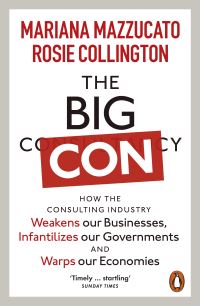
‘The Big Con’ describes the confidence trick the consulting industry performs in contracts with hollowed-out and risk-averse governments and shareholder value-maximizing firms. To make matters worse, our best and brightest graduates are often redirected away from public service into consulting. In all these ways, the Big Con weakens our businesses, infantilises our governments and warps our economies. Mazzucato and Collington expertly debunk the myth that consultancies always add value to the economy. With a wealth of original research, they argue brilliantly for investment and collective intelligence within all organisations and communities, and for a new system in which public and private sectors work innovatively for the common good. We must recalibrate the role of consultants and rebuild economies and governments that are fit for purpose.
-
£25.00
We all notice when the poor get poorer: when there are more rough sleepers and food bank queues start to grow. But if the rich become richer, there is nothing much to see in public and, for most of us, daily life doesn’t change. Or at least, not immediately. In this eye-opening intervention, philosopher and economist Ingrid Robeyns exposes the true extent of our wealth problem, which has spent the past 50 years silently spiralling out of control. In moral, political, economic, social, environmental and psychological terms, she shows, extreme wealth is not only unjustifiable but harmful to us all – the rich included. In place of our current system, Robeyns offers a breathtakingly clear alternative: limitarianism. The answer to so many of the problems posed by neoliberal capitalism – and the opportunity for a vastly better world – lies in placing a hard limit on the wealth that any one person can accumulate.
-
£12.99
Roger Backhouse’s definitive guide takes the story of economic thinking from the ancient world to the present day, with a brand-new chapter on the 21st century and updates throughout to reflect the latest scholarship.Covering topics including globalisation, inequality, financial crises and the environment, Backhouse brings his breadth of expertise and a contemporary lens to this original and insightful exploration of economics, revealing how we got to where we are today.
-
£10.99
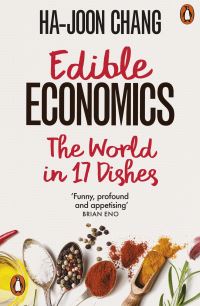
For decades, a single free market philosophy has dominated global economics. But this is bland and unhealthy – like British food in the 1980s, when bestselling author and economist Ha-Joon Chang first arrived in the UK from South Korea. Just as eating a wide range of cuisines contributes to a more interesting and balanced diet, so too is it essential we listen to a variety of economic perspectives. In ‘Edible Economics’, Chang makes challenging economic ideas more palatable by plating them alongside stories about food from around the world. Structuring the book as a series of menus, Chang uses histories behind familiar food items – where they come from, how they are cooked and consumed, what they mean to different cultures – to explore economic theory.
-
£12.99
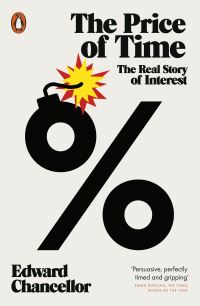
Capitalism and interest are inseparable, yet over the centuries whenever interest rates have collapsed and money was too easy, financial markets have become unstable. In the first two decades of the twenty-first century, interest rates have sunk lower than at any time in the five millennia since they were first recorded. In an unprecedented move, negative interest rates were introduced in Europe and Japan, causing trillions of dollars’ worth of bonds to trade at negative yields. Monetary policymakers appear blithe to the unintended consequences of their actions. Yet given the essential function of interest in determining how capital is allocated and priced, and its role in regulating financial risk, it is not clear that capitalism can thrive or even survive under these conditions.