Showing all 5 resultsSorted by latest
-
£24.85
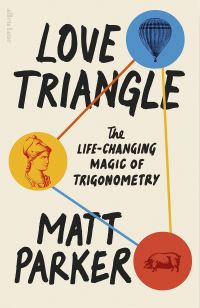
What happens when you pull a pop song apart into pure sine waves and play it back on a piano? What did mathematicians have to do with the great pig stampede of 2012? The answer to each of these questions can be found in the triangle. Humans have been using triangles for thousands of years to build structures, measure the earth, make music, paint vanishing points, pot snooker balls and much, much more. But trigonometry is not a thing of the past – triangles underpin all of modern data technology. When someone Snapchats a photo, the light travels into the camera as electromagnetic sine waves, Fourier analysis compresses the image and then trigonometry is used to send the data to someone else’s phone; when you listen to a track on Spotify, triangles remove the sounds which a human ear can’t perceive and reassemble the song so that it’s small enough to stream.
-
£9.99
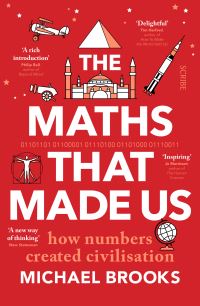
Quadratic equations, Pythagoras’ theorem, imaginary numbers, and pi – you may remember studying these at school, but did anyone ever explain why? Never fear – bestselling science writer, and your new favourite maths teacher, Michael Brooks, is here to help. In ‘The Maths That Made Us’, Brooks reminds us of the wonders of numbers: how they enabled explorers to travel far across the seas and astronomers to map the heavens; how they won wars and halted the HIV epidemic; how they are responsible for the design of your home and almost everything in it, down to the smartphone in your pocket. His clear explanations of the maths that built our world, along with stories about where it came from and how it shaped human history, will engage and delight.
-
£9.99
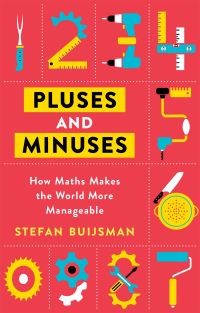
Thousands of years ago the inhabitants of Mesopotamia became the first to use numbers. Since then, mathematics has been unstoppable. It’s behind almost everything, from search-engines to cruise-control, from coffee-makers to timetables. But now that we hardly ever need to do arithmetic any longer, how relevant is mathematics to everyday life? ‘Pluses and Minuses’ demonstrates which role mathematics play in human endeavour. It begins with the mathematical skills we all possess from birth, to arrive at the many applications of mathematics today. It turns out that without knowledge of the ideas behind mathematical calculations we find ourselves sidelined. Can mathematics help us to treat cancer more effectively? Buijsman makes connections between philosophy, psychology and history, while explaining the wonderful world of mathematics for absolutely everyone.
-
£9.99
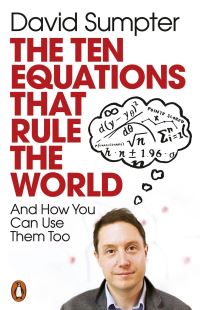
Is there a secret formula for getting rich? For making something a viral hit? For deciding how long to stick with your current job, Netflix series, or even relationship? This book is all about the equations that make our world go round. Ten of them, in fact. They are integral to everything from investment banking to betting companies and social media giants. And they can help you to increase your chance of success, guard against financial loss, live more healthily and see through scaremongering. They are known only by mathematicians – until now. With wit and clarity, mathematician David Sumpter shows that it isn’t the technical details which make these formulas so successful. It is the way they allow mathematicians to view problems from a different angle – a way of seeing the world that anyone can learn.
-
£18.99
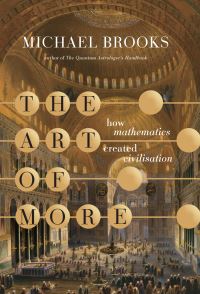
Bestselling science writer Michael Brooks takes us on a fascinating journey through the history of civilisation, as he explains why maths is fundamental to our understanding of the world. The untrained brain isn’t wired for maths; beyond the number 3, it just sees ‘more’. So why bother learning it at all? You might remember studying geometry, calculus, and algebra at school, but you probably didn’t realise – or weren’t taught – that these are the roots of art, architecture, government, and almost every other aspect of our civilisation. The mathematics of triangles enabled explorers to travel far across the seas and astronomers to map the heavens. Calculus won the Allies the Second World War and halted the HIV epidemic. And imaginary numbers, it turns out, are essential to the realities of 21st-century life.